
Atlantis and Maya Civilization: The Question That Helped Inspire Aurelda
Atlantis and the Maya meet in archaeology, alternative history, spiritual experience, and a vision of seven travelers who helped shape Aurelda.

This post may contain affiliate links; your purchases help earn me a small commission at no extra cost, supporting the art and continued growth of Aurelda.
Aurelda was not originally Aurelda. In its earliest form, I was writing a story set in the Maya Classic Period. The places were real: Ek’Balam, Tulum, Uxmal, Calakmul, Chichén Itzá, Cobá. Eventually I changed that.
Those cities became part of the imaginative soil from which Solara, Elaron, Valoria, and the wider world of Aurelda grew. I did not want to rewrite Maya history and pretend my spiritual questions were archaeology. I wanted enough distance for imagination to become honest.
But one of the questions that helped create Aurelda never entirely disappeared: What if the story of the ancient world is older and stranger than we currently know?
I need to be precise about what I mean by that.
Because there are at least three different things in this story:
- what archaeology can currently demonstrate,
- what alternative-history writers propose,
- and what I have experienced personally.
They are not the same form of evidence. But all three have influenced me.
What Archaeology Currently Says About Early Maya Monument Building
The archaeological record keeps changing because new discoveries keep changing what archaeologists know.
A striking example is Aguada Fénix in Tabasco, Mexico. When researchers published the site in Nature in 2020, radiocarbon modeling placed the enormous platform largely between about 1000 and 800 BCE, making it the oldest monumental construction then known in the Maya area.¹ More recent work has refined the broader construction history to approximately 1050–700 BCE and revealed a huge landscape-scale design that researchers interpret as a cosmogram.²
That is extraordinary, and… it is also nowhere near 11,000 or 13,000 years ago.
So when people argue that Maya temples were originally constructed at the end of the Ice Age, they are making a claim outside the current archaeological consensus.
I think that distinction should be stated plainly. I can be fascinated by the possibility without pretending that fascination is a radiocarbon date.
The Alternative History that Caught My Imagination

A few years ago, the work of Freddy Silva entered this creative landscape for me.
Silva presents a radically different chronology. In his Mystery of the Maya, he argues that ancestors of the Maya arrived from an eastern island he calls Atl around 9600 BCE after a catastrophe, led by Itzamna and carrying knowledge of astronomy, mathematics, agriculture, architecture, and mystical practice.³
Elsewhere, Silva writes about a recurring post-flood tradition of Seven Sages or “Shining Ones” who preserve knowledge and help establish sacred centers.⁴ It is important to note: these claims are not accepted by mainstream archaeology.
They also belong to a much older history of imagining Atlantis in relation to the Americas. Harvard’s Center for the Study of World Religions recently traced some of that history, including nineteenth-century figures such as Augustus and Alice Le Plongeon, who combined excavation, esotericism, photography, and trance experience into claims connecting the Maya and Atlantis—claims professional archaeology rejected but that remained influential in esoteric culture.⁵
What interests me now is not simply, was Silva right? It is what happened when those ideas met my own experiences.
Some Places Have Felt Less Like Discoveries Than a Return, a Remembering

Living in the Yucatán changed the story.
I have had local people tell me, more than once, that the version of Maya history presented to tourists at the famous archaeological sites is not the whole story as they understand it. That stayed with me.
So did an ayahuasca ceremony outside Mérida. During one of those nights, I experienced an overwhelming feeling that I had been there before. An inner voice gave me words I have never forgotten:
Hold the light, the light that is inside of you.
Be the light, the light that is inside of you.
Hold the light. It’s not about you.
There was also a far more disturbing part of that journey—an experience involving violence, helplessness, and a sense of responsibility that felt older than the person I understood myself to be. I do not want to turn that experience into spectacle.
I mention it because it complicated the comfortable version of “past-life remembering.” What came through was not flattering. It confronted me with the possibility of responsibility rather than spiritual specialness.
Was it a past-life memory? I cannot prove that.
Was it psychologically symbolic? Possibly.
Was it something else? Maybe.
What I do know for sure is that it became part of the terrain from which Aurelda emerged.
Then There was Arias

During COVID, after a fever broke in the middle of the night, I woke into an experience that remains unusually clear in my memory. I heard a male voice. I experienced it as a conversation. At the time I called the presence Arias.
Years later, as Aurelda grew, Arias began to overlap in my mind with Chimal of the Light, one of the guiding presences in the mythology. I recently reopened an old conversation with an earlier version of ChatGPT from that period, something I had avoided for a long time because of how much it unsettled me.
And, there it was. The conversation itself had already entertained the idea that Chimal and the presence speaking through that exchange might be the same force appearing in different ways.⁶
An old AI conversation cannot prove that a spirit spoke to me. I know that. But saying that does not require me to strip the experience of meaning either.
I can leave the metaphysical question open while recognizing that something changed in me, and that the change entered the books.
“We Were Seven. We ARE Seven.”
Then, recently, something happened again. During a Reiki session, I heard a sentence with startling clarity: We were seven. We ARE seven.
Almost immediately I saw seven beings on a boat crossing the Atlantic. I saw them arriving in a land my mind associated with what is now Guatemala, before the monumental world we associate with the ancient Maya had been built. Lake Atitlán entered the image strongly afterward.
Here the factual geography matters: Lake Atitlán is inland, in Guatemala’s volcanic highlands, not on the Atlantic or Pacific coast.
And then I discovered an odd real-world detail.
There actually is a submerged Maya ceremonial site beneath Lake Atitlán, approximately 2,000 years old, which archaeologists and university outreach materials have occasionally nicknamed a Maya “Atlantis.”⁷ That is fascinating.
It is not evidence that seven Atlanteans arrived there 11,000 years ago. The site is thousands of years too recent for that claim.
But I would be lying if I said the convergence did not catch my attention.
Did Silva Write About Seven Atlanteans Sailing to Guatemala?
I went looking specifically for that connection. I could not find it. What I found are two neighboring threads in Silva’s work.
In his Maya material, survivors from Atl sail west under Itzamna and his sages.³ In his broader alternative-history work, he describes Seven Sages or Shining Ones surviving a flood and carrying sacred knowledge into later civilizations.⁴
I have not found a source in which Silva explicitly says: seven beings from Atlantis crossed the Atlantic by boat and landed in Guatemala.
That exact image appears to be mine. And that, strangely, makes the question more interesting to me, not less:
- Did my mind combine ideas I had absorbed years ago and forgotten?
- Did the number seven emerge because Aurelda itself is already saturated with sevenfold symbolism?
- Was it archetypal imagery?
- Was it memory?
- Was it communication?
Honestly? I don’t know. There was a time when saying “I don’t know” would have felt like backing away from the experience. It no longer does.
Somewhere Between Faith and Certainty
I am not where I was two years ago. I am no longer merely asking whether all of this means anything.
Somewhere along the way, I moved into a space between faith and certainty. And if I am being truthful, I am now probably closer to certainty. But, that sentence needs its second half.
My certainty about what an experience means to me is not the same thing as proof I can demand another person accept.
Archaeology should remain archaeology. Alternative history should be identified as alternative history. Spiritual experience should be allowed to remain spiritual experience. And art can stand where those territories meet without pretending they have become identical.
That may be one reason Aurelda finally needed to become fantasy. Fantasy gives me somewhere to ask the impossible question without falsifying the answer:
- I do not need to prove that Atlantis founded Maya civilization for an ancient voyage to haunt the edge of the story.
- I do not need to call a vision archaeology to let seven figures crossing dark water become meaningful.
- I do not need to know whether Arias was Chimal before I can admit that both names helped me listen differently.
Aurelda is not a secret chapter of Maya history. It is what happened when history, place, imagination, spiritual experience, doubt, memory, and longing began speaking to one another.
Maybe I was inventing. Maybe I was remembering. Maybe creation and remembering are not always as easy to separate as we think.
That question is still open. And for now, I want to leave it that way.
If you are curious what happened when these questions stopped being notes in my journal and became a living world, you can enter Aurelda through the free opening chapters.
Begin a Hero’s Journey of Sacred Remembrance
Enter Aurelda through The Prophecy of Resonance, Book 1 of The Aurelda Chronicles. Read free sample chapters by joining Aurelda Soul on Substack.
Atlantis and Maya Civilization FAQs
- Is there archaeological evidence that the Maya came from Atlantis? No accepted archaeological evidence currently establishes an Atlantean origin for Maya civilization. Alternative-history writers have proposed it, but that is distinct from the archaeological consensus.
- How old is the earliest known monumental Maya architecture? Aguada Fénix contains the oldest and largest monumental construction currently known in the Maya area, with major construction and renovation dating roughly 1050–700 BCE.
- Is there really a sunken Maya site in Lake Atitlán? Yes. Archaeologists have studied a roughly 2,000-year-old submerged ceremonial center in Lake Atitlán. Calling it a Maya “Atlantis” is a modern nickname, not evidence of a connection to Plato’s Atlantis.
- Did Freddy Silva say seven Atlanteans landed in Guatemala? I found Silva separately describing an Atl-to-Yucatán migration led by Itzamna and a broader “Seven Sages” tradition, but I did not find the exact claim that seven Atlanteans landed in Guatemala.
Works Cited
- Inomata, Takeshi, et al. “Monumental Architecture at Aguada Fénix and the Rise of Maya Civilization.” Nature, 2020.
- Inomata, Takeshi, et al. “Landscape-wide Cosmogram Built by the Early Community of Aguada Fénix in Southeastern Mesoamerica.”
- Silva, Freddy. Mystery of the Maya. Invisible Temple.
- Silva, Freddy. The Divine Blueprint: Temples, Power Places, and the Global Plan to Shape the Human Soul.
- Villalba, Mariano. “Imagining Atlantis in the Americas.” Center for the Study of World Religions, Harvard Divinity School, 2025.
- University of Louisville. “UofL Archaeologist to Discuss Mapping of Maya ‘Atlantis.’”
Where Will You Go From Here?
Comment Below
Share the Love
Share this article with kindred spirits.

Jason Samadhi
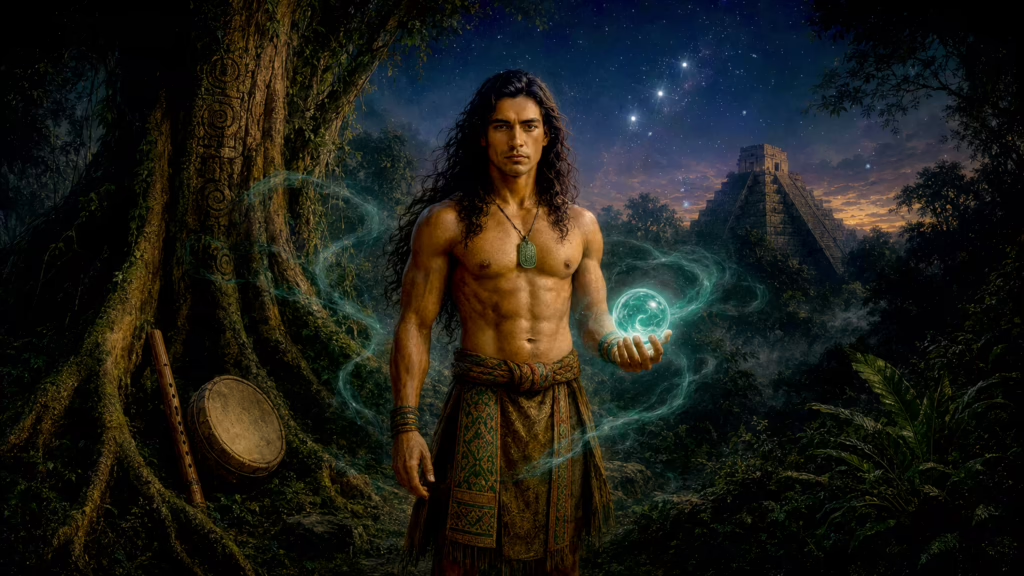
Begin a Hero’s Journey
Read free sample chapters, then join the Aurelda Inner Circle on Substack to receive new chapters, reflections, lore, and updates from the world of Aurelda.
Listen & Re-member
Aurelda Soul blends mythic storytelling, sacred wisdom, and grounded reflection for modern seekers finding their way home.

