
Cultural Appropriation in Fantasy: What a Book Cover Cannot Tell You
A personal essay on cultural appropriation in fantasy, the white savior trope, Maya-inspired storytelling, queer identity, belonging, and remembering.

This post may contain affiliate links; your purchases help earn me a small commission at no extra cost, supporting the art and continued growth of Aurelda.
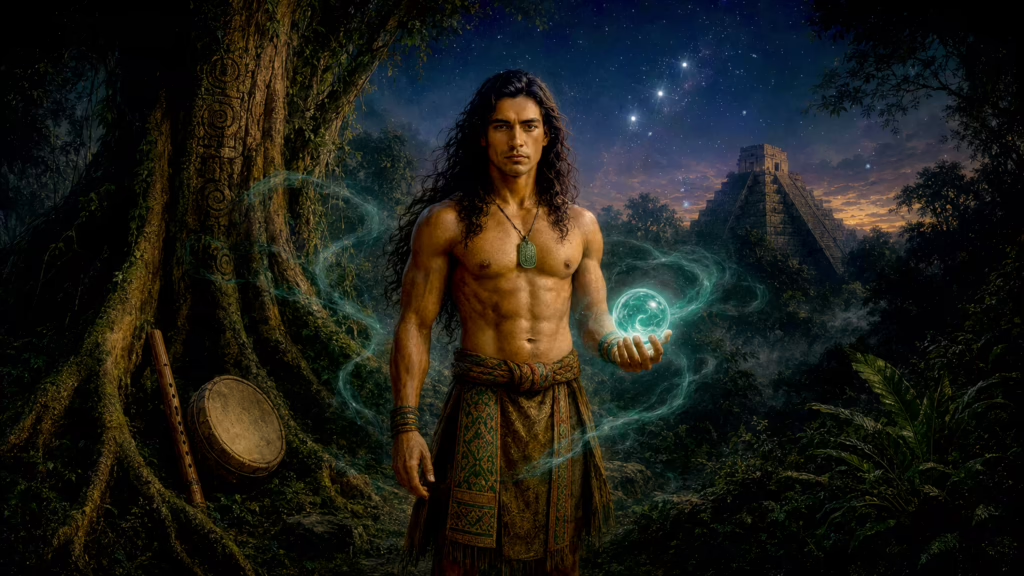
When I look at Mo’an, I know I am biased. I created him. Of course I wanted him to be beautiful. But beauty is almost the least interesting thing I see now.
I see someone gentle, patient, wise, and present. Someone who has known pain without allowing it to harden him. Someone who feels deeply, loves freely, and knows who he is and who he loves. Whether I understand Mo’an as a presence across the veil, a creation of imagination, or somehow both, that is the man I recognize.
A cover cannot show most of that. It can show a body, a jungle, a glowing orb. Visual shorthand can make us think we already know the story before we have read a page.
That is where my questions about cultural appropriation in fantasy, the “white savior” trope, and Aurelda begin.
What a cover cannot tell you

I can understand how someone seeing Aurelda only through its imagery might reach for a familiar comparison: Tarzan, an exotic jungle hero, an exceptional male figure centered in a Mesoamerican-coded world.
But an association is not an analysis.
Mo’an is not an outsider who arrives with superior knowledge to rescue people waiting for him. He is born into Aurelda, formed through its relationships, taught by people whose knowledge precedes him, and given responsibility within a world with its own history, conflicts, scholarship, governance, and purpose.
The outsider who arrives later is named Jason. He is the Aurelda version of me. But he is not exactly a hero, and he is not a villain. He is a man in pieces.
He does not carry the answers. He needs to listen, learn, and confront what pain and forgetting have done to him. In many ways, Jason needs Aurelda more than Aurelda needs rescuing by Jason.
Sociologist Matthew Hughey describes white-savior stories as narratives in which white protagonists retain the real power, drive the action, and become the solution to other people’s conflicts. That gives us better questions than appearance alone: Who knows? Who acts? Who decides? Who exists only so someone else can become heroic?
Those questions can be asked of Aurelda. They should also be answered by the story.
Influence, belonging, and Mexico

I am a gay white American man who has lived in Mexico for more than nine years. Aurelda is openly Maya- and Mesoamerican-inspired. I do not claim Maya identity, and I do not present Aurelda as historical Maya culture.
I also do not believe cultural appropriation accurately describes what I am doing with Aurelda.
That does not mean influence carries no responsibility. Richard Rogers distinguishes among exchange, dominance, exploitation, and transculturation rather than treating every cross-cultural influence as identical. Writer Nisi Shawl likewise challenges the idea that the only ethical choices are careless borrowing or never writing across cultural difference. Relationship, context, distortion, and acknowledgment matter.
For me, Mexico is not a costume placed over Aurelda. It is part of the life from which Aurelda emerged.
I often say Mexico healed my heart. I learned poco a poco here, not because Mexico is some romantic place where everything moves slowly, but because patience became something I had to live. More importantly, people made room for me. Someone made space at the dinner table because they knew I was struggling. People opened their homes when I might otherwise have had nowhere to go.
That does not make Mexico mine. It means I have been changed by relationship.
What I mean by remembering

In The Prophecy of Resonance, Mo’an describes remembering this way: “How to breathe without fighting myself. How to listen.”
Remembering, I think, is not recovering some untouched self from before pain. It is learning to inhabit ourselves after pain without letting pain become the whole definition.
That is why Mo’an matters to me. He has suffered, but suffering has not closed him. Jason is different: wounded, dislocated, still trying to understand who he is. I wrote one man who knows how to remain present to himself and another who has forgotten how to come home.
Book Three gives Mo’an a line that now feels relevant beyond the scene: “His body felt too visible, and yet utterly unseen.”
A beautiful body can be immediately legible. A human being takes longer. So does a story.
Creating when almost nobody is watching

I have spent years building Aurelda through books, imagery, audio, websites, video, and podcasts, often with very little visible response.
There were times Aurelda was an escape. After Mila, my golden retriever, died, it became something more. It gave me somewhere to place grief. It gave me purpose. It continued to give me joy.
Of course I want readers. But silence has taught me something too.
Maybe remembering is also returning to what remains alive in you when the outside world does not confirm its value. Not ignoring criticism. Not pretending an audience does not matter. Simply refusing to let an algorithm, a market, a label, or someone’s first impression become the only authority on why the work exists.
A cover can make a man visible without making him known. A label can name a legitimate question without answering it. A story can be shaped by a place without claiming to own that place.
I do not need Aurelda to be beyond question. I want it to be encountered beyond reduction.
If you are curious, do not take my reassurance as proof. Read the story and decide what it is doing for yourself.
Begin a Hero’s Journey of Sacred Remembrance
Enter Aurelda through The Prophecy of Resonance, Book 1 of The Aurelda Chronicles. Read free sample chapters by joining Aurelda Soul on Substack.
Works Cited
- Best, Kenneth. “The White Savior: Racial Inequality in Film.” Interview with Matthew Hughey. UConn Today, 2016.
- Rogers, Richard A. “From Cultural Exchange to Transculturation: A Review and Reconceptualization of Cultural Appropriation.” Communication Theory, 16.4, 2006.
- Shawl, Nisi. “Appropriate Cultural Appropriation.” Writing the Other: A Practical Approach. Aqueduct Press, 2005.
- Samadhi, Jason. The Aurelda Chronicles. Third editions, 2026.
Where Will You Go From Here?
Comment Below
Share the Love
Share this article with kindred spirits.

Jason Samadhi
Begin a Hero’s Journey
Read free sample chapters, then join the Aurelda Inner Circle on Substack to receive new chapters, reflections, lore, and updates from the world of Aurelda.
Listen & Re-member
Aurelda Soul blends mythic storytelling, sacred wisdom, and grounded reflection for modern seekers finding their way home.

