
Fantasy Magic Systems: What If Magic Meant Listening Instead of Commanding?
Fantasy magic systems have taught us to recognize the wizard who commands supernatural power. Ahau’Tun offers another possibility: an elder who listens to land, breath, ritual, and the living world.

This post may contain affiliate links; your purchases help earn me a small commission at no extra cost, supporting the art and continued growth of Aurelda.
What If Fantasy Magic Systems Meant Listening Instead of Commanding?

Most fantasy teaches us to recognize magic before anyone explains it. A robed figure raises a staff. A wand cuts through the air. Words are spoken, light appears, and reality obeys.
Gandalf and Albus Dumbledore are very different characters, written in very different traditions, but both belong to a fantasy lineage most readers recognize immediately: the learned magical elder. Power gathers around knowledge, language, artifacts, secret disciplines, and the ability to do what ordinary people cannot.
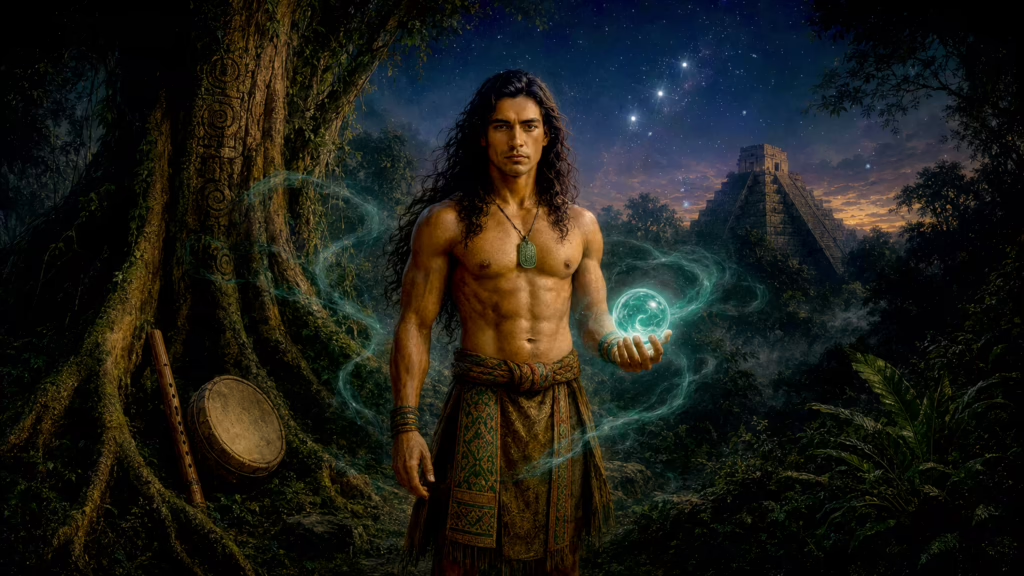
When I began shaping Ahau’Tun in The Aurelda Chronicles, I found myself moving in almost the opposite direction.
Ahau’Tun is an elder, healer, teacher, and ritual guide. He knows things other people do not. He can stand in situations that feel unmistakably magical. Yet the more clearly I understood him, the less he resembled a wizard who imposes his will on nature. His deepest skill is listening.
Fantasy Magic Usually Asks Who Can Wield the Power
Modern fantasy readers often talk about fantasy magic systems: where power comes from, what rules govern it, what it costs, and what a character must do to use it. The University of Chicago Library describes the familiar spectrum between mysterious “soft” magic and rule-bound “hard” magic, where supernatural power can begin to function almost like a technology.¹
Aurelda has rules too. But its central force, the Lumina, is not a battery waiting for the right person to operate it. The Lumina is the living current that moves through land, water, breath, memory, relationship, and living beings. It can be felt. It can be studied. It can be disrupted.
But the important question is not: How powerful are you? Rather, it is: Are you listening? That changes what a magical elder can be.
Ahau’Tun does not need to hurl fire from his hands to be powerful. He may sit beside someone in grief. He may burn copal, listen to the wind, place a hand against the bark of a Ceiba, guide breath, call people into shared rhythm, or notice that the land feels wrong before anyone can explain why.
What looks like magic from the outside is often relationship from the inside.
Ahau’Tun Is Closer to a Ritual Specialist than a European Wizard

Words such as shaman and curandero can give a modern reader an entry point, but neither is an exact label for Ahau’Tun.
“Shaman” has become an enormous umbrella word in English, often placed over traditions that have their own names and roles. In Yucatec Maya communities, a more specific comparison is the jmeen or h-men: a ritual specialist associated with healing and agricultural ceremony.
Sources from the Universidad Autónoma de Yucatán distinguish the jmeen from other healers, including curanderos, while acknowledging overlap among specialties. Jmeeno’ob may conduct agricultural rites, make offerings, pray, attend to illness, interpret dreams, and work inside a worldview where health, community, land, weather, plants, and sacred forces remain connected.²
That interests me because it moves us away from the solitary sorcerer. The ritual specialist does not necessarily stand above nature. He stands inside a web of obligations.
Ahau’Tun is still an Aureldian character, not a fictionalized Maya jmeen. Aurelda has its own cosmology. But understanding that real-world distinction helps explain why his authority feels so different from the European wizard archetype.
His wisdom is not primarily about possessing secret techniques. It is about knowing how to enter into relationship responsibly.
What if a Spell Were an Act of Attunement?

Without giving away what happens later in the story, Aureldian protective ritual can involve copal smoke, drums, chant, offerings, breath, touch, and people gathering around a living Ceiba.³
No one points at the forest and orders it to obey. People become quiet enough to participate.
Their breathing changes. Attention gathers. Sound becomes communal. Hands meet bark. Offerings establish reciprocity. The natural world is not scenery surrounding the ritual. Nature is one of its participants.
You could call that magic. You could call it prayer, ceremonial practice, animism, resonance, or embodied relationship with the land. In Aurelda, the name matters less than the posture.
- Command says: I have power, therefore the world should answer me.
- Attunement asks: What is already moving here, and how do I enter it without breaking the relationship?
That difference eventually becomes one of the great pressures inside Aurelda.
The Healer and Caretaker Are Not Secondary Characters
Fantasy often reserves its largest moments for warriors, kings, chosen heroes, and spectacular magic users. Care happens somewhere off to the side.
Ahau’Tun makes me question that hierarchy. His power is often expressed through staying.
He holds space for people who are frightened, grieving, confused, wounded, or not yet ready to understand themselves. He teaches without needing to dominate. He can be stern, but his authority comes from responsibility rather than spectacle.
A healer treats an injury. A caretaker notices what must remain protected long enough for healing to become possible. Ahau’Tun is both.
That matters to me because some of the deepest changes in a life do not happen when somebody defeats an enemy. They happen because someone older stays near the bed. Because somebody knows which plant to prepare. Because somebody listens without demanding an answer. Because someone recognizes that a frightened young person does not need another command.
They need somewhere safe enough to hear themselves again.
Maybe Magic Was Never About Making Nature Obey

That is one of the doorways Aurelda offers into fantasy. Aurelda asks:
- What if the most advanced magic were not domination of the elements, but intimacy with them?
- What if earth, water, fire, air, tree, body, and breath were not ingredients in a spell, but living presences with which the practitioner had to maintain relationship?
- What if power became more dangerous—not more impressive—the moment someone stopped listening?
That is where Ahau’Tun stands for me. He is not Aurelda’s version of Gandalf or Dumbledore wearing different clothes. He begins from another assumption about what wisdom is for.
The elder is not the person who accumulated enough power to command the world. He is the person who has listened long enough to know when the world is answering.
And perhaps that is why, when Aurelda becomes loud, Ahau’Tun so often leads us toward something quieter: breath, root, touch, smoke, water, presence.
Magic does not always begin with a spell. Sometimes it begins when someone finally listens.
If this is the kind of magic you have been looking for—less domination, more relationship—you can begin with the free opening chapters of The Aurelda Chronicles.
Begin a Hero’s Journey of Sacred Remembrance
Enter Aurelda through The Prophecy of Resonance, Book 1 of The Aurelda Chronicles. Read free sample chapters by joining Aurelda Soul on Substack.
Fantasy Magic Systems FAQs
- Is the Lumina a magic system? It functions as Aurelda’s supernatural framework, but it is deliberately relational rather than a power characters simply cast or control.
- Is Ahau’Tun a shaman? Not literally. He is an Aureldian elder, healer, teacher, and ritual guide. Real Yucatec Maya traditions offer more precise concepts such as the jmeen/h-men, which help illuminate the difference without defining him.
- Does Aurelda have spells? Aurelda has rites, invocation, ceremony, sacred objects, breath, sound, and interaction with the Lumina, but its deepest power is based on attunement rather than conventional spellcasting.
Works Cited
- University of Chicago Library. “Magic Systems — Charting Imaginary Worlds.”
- Universidad Autónoma de Yucatán. “Yucatán: Identidad y Cultura Maya.”
- Gubler, Ruth. “El papel del ritual y la religión en la terapéutica de los curanderos y h-meno’ob yucatecos actuales.” Anales de Antropología.
Where Will You Go From Here?
Comment Below
Share the Love
Share this article with kindred spirits.

Jason Samadhi
Begin a Hero’s Journey
Read free sample chapters, then join the Aurelda Inner Circle on Substack to receive new chapters, reflections, lore, and updates from the world of Aurelda.
Listen & Re-member
Aurelda Soul blends mythic storytelling, sacred wisdom, and grounded reflection for modern seekers finding their way home.

