
Queer Fantasy Worldbuilding: What If Male Intimacy Wasn’t a Problem to Solve?
Ah’Chaan’s past raises a provocative question: what if intimacy between men could include pleasure, ritual, and tenderness without becoming a crisis of identity?

This post may contain affiliate links; your purchases help earn me a small commission at no extra cost, supporting the art and continued growth of Aurelda.
What If Male Intimacy Wasn’t a Problem to Solve?
A great deal of queer storytelling begins with a problem. Someone desires the wrong person. Someone has to hide. Someone is discovered. Someone fears what a sexual encounter means about him. Those stories matter because those realities exist.
But fantasy gives us another possibility. We can build a world in which being queer is not the wound. That sounds simple until you follow the idea all the way into the body.
In The Aurelda Chronicles, Ah’Chaan is a man whose great romantic love is a woman, Ix’Quil. Yet an early memory reveals that, as a young man entering adulthood, he participated in a communal rite guided by the elder Ahau’Tun. The published scene describes prolonged chant, intentional touch and movement, shared vulnerability, release from shame, and a sacred fluidity linking body, spirit, the other participants, and the Lumina.¹
Later, Ah’Chaan remembers the experience more plainly: there was intimacy with other men. For him, it was not primarily about sexual desire. It was about understanding connection.² That distinction is where things get interesting.
I Did Not Imagine a Sanitized Ceremony

When I conceived that scene, I conceived the participants as young adult men. And I did not picture a group of fully clothed men touching one another’s shoulders while the prose politely looked away.
The erotic vocabulary in my imagination was much wider: nudity, erections, masturbation, genital touch, oral sex, perhaps intercourse. The published book does not tell us which of those acts occurred. I no longer think that is a weakness.
The ambiguity allows the scene to remain bodily and erotic without turning a rite of passage into a checklist of sexual choreography. What matters is not whether Ah’Chaan can later say, “I performed Act A with Man B.”
What matters is that his body crossed a boundary his society did not teach him to fear. He could be touched by men. He could touch men. Pleasure could exist. Vulnerability could exist. Bodies could respond.
And none of that required him to emerge from the ceremony with a new label. That is quite different from pretending the encounter was not sexual.
It is also different from the familiar gay-male fantasy trope in which every charged glance between men exists primarily to set up a romance or sex scene. Erotic charge can be real without being the only meaning in the room.
What If “Straight” or “Gay” are Not the First Questions?
I sometimes describe Ah’Chaan as essentially heterosexual because that is how his enduring romantic and erotic life reads in the story. But Aurelda does not require his intimacy with men to become a contradiction that needs explaining away.
He does not have to say: that never happened.
He also does not have to say: because that happened, everything I thought about myself was false.
Those are recognizably modern pressures.
Aurelda asks another question: What did the experience teach him about being human?
That matters later when Ah’Chaan is asked to understand forms of love that are not his own. His acceptance does not come from abstract tolerance. His body already taught him that intimacy, tenderness, pleasure, and masculine identity do not have to live behind rigid walls.
That is a very different foundation for queer fantasy worldbuilding. Being gay or sexually fluid does not need to be the social problem around which the world is organized.
People can have other problems. Power can corrupt. Families can fracture. Nations can become afraid. Sacred things can be exploited. Who you love does not have to be the catastrophe.
The Real Maya Evidence is More Complicated, and More Interesting
There are historical echoes here, but I want to keep them precise.
Archaeologist Stephen Houston’s work on Classic Maya young men found evidence that male youth formed an important social category and that homosocial and homoerotic currents were part of that world, although the evidence is intermittent and strongly skewed toward elite society.³ Houston and Karl Taube have also written that ancient Maya sexual identity could be more fluid than modern categories readily accommodate.⁴
Historian Pete Sigal goes further into the relationship between sexuality and ritual. His work argues that preconquest Maya sexuality belonged within ritual discourse and performance, where sexual acts could carry social and cosmological meanings beyond individual preference.⁵
That does not prove that Classic Maya communities practiced the exact group initiation I wrote for Ah’Chaan.
There is no responsible scholarly bridge from those sources to the statement: “Maya young men had ceremonial gay orgies as rites of passage.” I cannot support that claim, so I will not make it.
But the evidence does challenge another assumption: that modern Western categories of sexual identity, shame, privacy, and acceptable male intimacy can simply be projected backward unchanged. They cannot.
And that opening is creatively fertile.
Sacred Sexuality is Not just Fantasy Sex with Incense
There is another distinction I care about, particularly for gay male readers. Gay fantasy can be hot. There is nothing wrong with that.
Men wanting men, naked male bodies, erections, mouths, hands, sweat, penetration, pleasure—none of these things become less worthy of literature because they are explicitly erotic. But sacred sexuality is not created simply by adding candles, chanting, or spiritual vocabulary to sex.
The sacredness in Ah’Chaan’s memory comes from the relationship among vulnerability, consent, presence, body, community, and meaning.
No participant needs to conquer another. No one has to prove masculinity by remaining untouched.
Pleasure is not evidence of moral failure. Nor does pleasure automatically demand a permanent identity.
For a gay man reading that scene, there may still be erotic appeal. I do not want to sterilize that away. I want the eroticism to have somewhere larger to live.
A World Where Queerness is Normal Still has Something to Say

Sometimes people assume a queer-affirming fantasy world removes dramatic tension. I think it changes where we look for the tension.
If two men can love each other without the world collapsing, the story has to ask more interesting questions than whether they are allowed to kiss.
- How do they love?
- How do they handle power?
- What does fidelity mean?
- What does community ask of them?
- What happens when desire and spiritual responsibility pull in different directions?
- How does a man respond when an experience falls outside the identity he thought described him?
- And what becomes possible when nobody tells him he has to hate himself for it?
Ah’Chaan’s rite gives Aurelda an early answer.
- The body can teach without becoming a verdict.
- Two men can touch without the touch becoming shame.
- Pleasure can be erotic without becoming trivial.
- A sacred experience can include sex without pretending sex is automatically sacred.
- And a man can encounter another man’s body without having to spend the rest of his life proving what it did—or did not—make him.
Maybe that is one of the freedoms fantasy is uniquely able to offer us: not a world without sexuality, but a world in which sexuality is no longer required to become a wound.
If you want to see what a fantasy world looks like when queer love is not the original sin, begin with the free opening chapters of The Aurelda Chronicles.
Begin a Hero’s Journey of Sacred Remembrance
Enter Aurelda through The Prophecy of Resonance, Book 1 of The Aurelda Chronicles. Read free sample chapters by joining Aurelda Soul on Substack.
Queer Fantasy Worldbuilding FAQs
- Is Ah’Chaan gay or bisexual? The canon does not label him that way. His enduring romantic relationship is with Ix’Quil, while his remembered initiation includes sacred intimacy with men. Aurelda allows those facts to coexist without forcing a modern label onto him.
- Did the ancient Maya have same-sex relationships? Scholars have identified homoerotic and homosocial evidence and more fluid sexual categories, but the surviving record is incomplete and cannot support sweeping claims about one universal Maya attitude.
- Was Ah’Chaan’s rite based on a real Maya ceremony? No specific historical Maya rite is being reconstructed. The Aureldian ceremony is fictional, while drawing thematic inspiration from scholarship on Maya ritual, embodiment, sexuality, and male social life.
Works Cited
- Houston, Stephen. “A Splendid Predicament: Young Men in Classic Maya Society.” Cambridge Archaeological Journal, 2009.
- Houston, Stephen, and Karl Taube. “La sexualidad entre los antiguos mayas.” Arqueología Mexicana.
- Sigal, Pete. From Moon Goddesses to Virgins: The Colonization of Yucatecan Maya Sexual Desire. University of Texas Press.
Where Will You Go From Here?
Comment Below
Share the Love
Share this article with kindred spirits.

Jason Samadhi
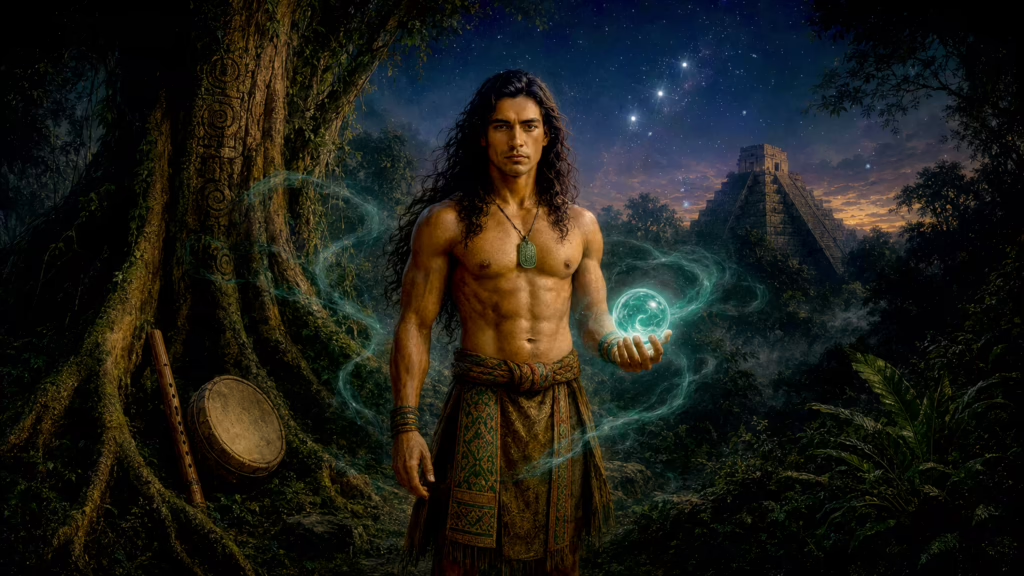
Begin a Hero’s Journey
Read free sample chapters, then join the Aurelda Inner Circle on Substack to receive new chapters, reflections, lore, and updates from the world of Aurelda.
Listen & Re-member
Aurelda Soul blends mythic storytelling, sacred wisdom, and grounded reflection for modern seekers finding their way home.

