
Beyond Generational LGBTQ+ Trauma Dynamics and Reclaiming the Authentic Self
An exploration of generational LGBTQ+ dynamics, app burnout, and somatic trauma integration through story as medicine and authentic self-remembrance.

This post may contain affiliate links; your purchases help earn me a small commission at no extra cost, supporting the art and continued growth of Aurelda.
Sociological and Historical Trajectories of LGBTQ+ Generational Cohorts
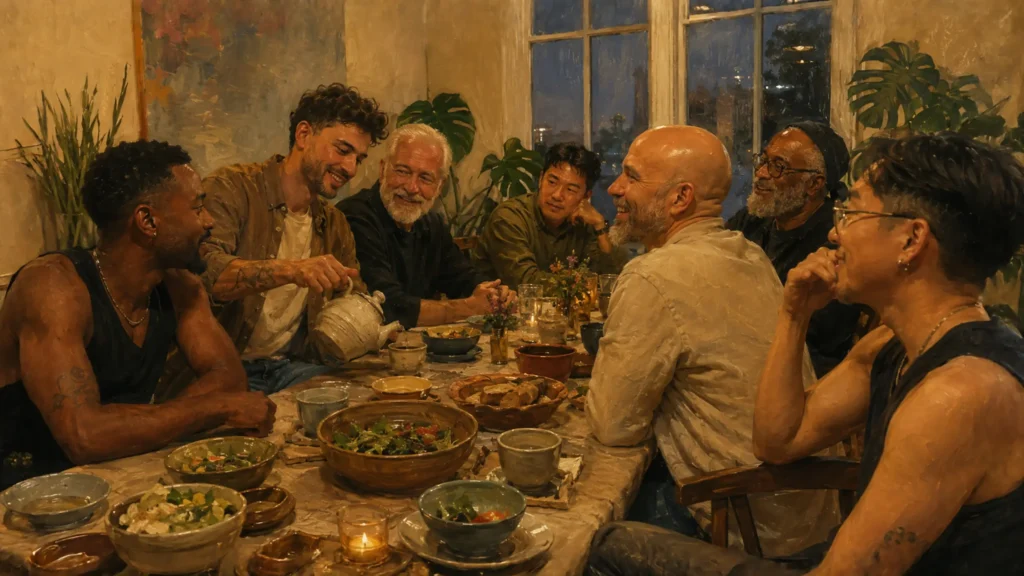
The trajectory of LGBTQ+ life across the past half-century represents one of the most rapid socio-cultural transformations in modern history.
However, this sociological evolution has produced distinct generational cohorts whose understandings of identity disclosure, relationship construction, and community integration are fundamentally shaped by the socio-political contexts in which they came of age.
Sociological research conceptualizes this developmental phenomenon through the framework of “generational layering,” wherein sexual minority individuals are dually influenced by their heteronormative birth generation and their specific “queer coming-of-age cohort”.
Empirical data from the Williams Institute Generations Study reveals a dramatic temporal compression of developmental identity milestones across successive cohorts.
While the median baseline age of initial same-sex attraction has remained constant at approximately 14 years across older, middle, and younger cohorts, the temporal gap between internal self-awareness and public disclosure (“coming out”) has contracted significantly.
Older cohorts (Baby Boomers and early Generation X) experienced an average gap of eight to twelve years between self-identification and disclosure to family members, whereas contemporary Generation Z youth navigate this transition within zero to three years.
National population survey data indicates that two-thirds of sexual minority adults aged 18 to 29 disclosed their orientation prior to age 18, with 31% coming out at age 13 or younger.
This compression of developmental milestones has fundamentally altered the psychological function of identity disclosure. For older generations who navigated the devastation of the HIV/AIDS epidemic, coming out represented a high-stakes, disruptive existential threshold requiring immense political courage and risking total economic and familial rejection.
Public cultural figures, such as activist Pedro Zamora on MTV’s The Real World in 1994, provided vital beacons of authentic representation, demonstrating that living openly as an HIV-positive gay man was an act of political resistance, education, and survival.
Conversely, younger cohorts increasingly view identity disclosure as an expression of personal authenticity and individual branding rather than a sociopolitical rupture.
However, early identity disclosure has introduced what epidemiological researchers identify as the “Adverse Childhood Experiences (ACEs) Paradox”.
Behavioral Risk Factor Surveillance System (BRFSS) data shows that despite overall cultural progress, younger LGBTQ+ adults report significantly higher cumulative exposure to four or more ACEs, including intra-familial emotional abuse, physical violence, and domestic instability, than older cohorts experienced at comparable developmental stages.
Because younger individuals disclose their sexual orientation during early adolescence rather than late adulthood, their exposure to parental rejection and peer victimization occurs during a period of acute neurobiological and developmental vulnerability.
This vulnerability is compounded by contemporary legislative polarization and geographic disparities. National survey data from The Trevor Project indicates that over 90% of LGBTQ+ youth report that state-level debates and legislative proposals restricting healthcare and public expression have directly heightened their daily anxiety and psychological distress.
In states with restrictive policies, transgender and nonbinary youth who are denied desired gender-affirming medical care report double the rate of suicide attempts compared to peers who access care.
A stark urban-rural divide further persists: while metropolitan coastal enclaves offer integrated civic spaces, rural environments frequently lack affirming resources, leaving marginalized youth reliant on digital platforms for survival.
Intraminority Stress, App Architecture, and the Erosion of Third Spaces

In addition to distal minority stressor, such as systemic discrimination and legislative hostility, sexual minority populations encounter severe proximal and subcultural stressors. Ilan Meyer’s Minority Stress Model posits that chronic, additive psychological stress arises from both external prejudice and internalized negative societal attitudes.
Within gay male subculture, this dynamic manifests as Intraminority Gay Community Stress, a secondary vector of psychological distress driven by status competition, hyper-sexualization, and rigid aesthetic hierarchies.
Mainstream gay male environments frequently enforce a social hierarchy governed by four dominant pillars: hyper-muscular body aesthetics, youthfulness, high socio-economic status, and hyper-masculinity.
Individuals who do not conform to these attributes experience subcultural marginalization and internalized gay ageism, leading to elevated rates of body image dysmorphia, social anxiety, and Unhealthy Weight Control Behaviors (UWCBs).
The migration of gay social life from physical locations to image-centric geosocial networking applications (such as Grindr) has intensified these intraminority pressures.
App user interfaces utilize location-sorting grids, endless scrolling, and instantaneous rejection mechanisms (“blocking” or “tapping”) that encourage the objectification and commodification of human beings:
- For the recipient, sudden non-dialogic rejection activates rejection sensitivity and social anxiety, reinforcing internalized feelings of unworthiness.
- For the initiator, routine blocking reinforces avoidant attachment patterns, training individuals to treat partners as disposable consumer choices and undermining the capacity for vulnerability and long-term emotional intimacy.
This digital migration coincides with a steep decline in physical “third spaces”—informal gathering environments beyond the home (first space) and workplace (second space) essential for social cohesion, intergenerational dialogue, and political organizing.
Between 2007 and 2019, physical gay bars and community establishments in the United States declined by 36.6%, a trend driven by real estate gentrification, app adoption, and commercial shift.
The loss of these non-digital spaces has severed the vital conduit through which older cohorts transmitted historical survival wisdom and coping strategies to younger generations.
Consequently, younger queer individuals are deprived of historical context, while older adults face acute social isolation, being twice as likely to live alone and three to four times less likely to have children than their heterosexual peers.
Narrative Medicine and the Backstory of the Author

The narrative foundation of The Aurelda Chronicles emerges directly from the authentic real-world trajectory of my own life path illustrates the long-term interaction between severe adverse childhood experiences, intergenerational family secrecy, and adult trauma response.
Having survived early childhood paternity concealment, intra-familial abuse, and a domestic environment governed by strict maternal codes of silence to preserve image, I’ve learned to adapt by developing hyper-vigilance, emotional inhibition, and deep-seated self-loathing.
In early adulthood, these unprocessed childhood wounds manifested as what Alan Downs calls stage 2 compensatory perfectionism, initiating a seventeen-year cycle of building successful professional ventures across major cities, only to experience sudden emotional dysregulation, self-sabotage, and impulsive relocations.
My move to Playa del Carmen, Mexico, exposed the illusion of geographic escape, a period of my life I call the “prison in paradise,” where an external tropical environment could not dismantle an internal panopticon of financial panic, relational codependency, and somatic intimacy blockages.
When relational mirroring highlighted these intimacy barriers. Those experiences forced me to face the fundamental truth that spatial escape cannot substitute for shadow integration.
This profound realization served as the catalyst for writing The Aurelda Chronicles, transforming my personal grief and somatic recovery into a living narrative container designed to metabolize developmental trauma through story.
The Aurelda Chronicles: Story as Medicine and Authentic Self-Remembrance

The resulting trilogy—comprising Book 1: The Prophecy of Resonance, Book 2: The Fractured Remembers, and Book 3: Two Return to One—operates as a mythic architecture that functions simultaneously as clinical-grade narrative medicine and non-violent counter-storytelling.
Grounded in Rita Charon’s framework of Narrative Medicine and Daniel Solórzano’s Critical Counter-Storytelling, the series provides readers with an archetypal structure through which developmental trauma, internalized shame, and existential isolation can be metabolized.
The Aurelda Chronicles addresses modern psychological fragmentation by bridging ancient Mesoamerican-inspired cosmology with contemporary human struggles, opposing imperial resource extraction with relational attunement, sacred anointing, non-binary gender fluidity, and intergenerational remembrance.
In an era marked by algorithmic atomization, legislative hostility, and subcultural body obsession, the trilogy provides an essential value proposition: “remembering your authentic self” does not represent vague New Age escapism or spiritual bypassing, but rather the rigorous, somatic unravelling of societal conditioning, compensatory facades, and the architecture of amnesia.
It restores baseline human dignity, presence, and relational connection, demonstrating now more than ever that true liberation begins when individuals cease abandoning themselves and return home to embodied wholeness.
Begin a Hero’s Journey of Sacred Remembrance
Enter the world of Aurelda through The Prophecy of Resonance, Book One of The Aurelda Chronicles. Begin the journey with free sample chapters of Book 1.
Works cited
- Generations – Williams Institute – UCLA, https://williamsinstitute.law.ucla.edu/projects/generations/
- Understanding Generation Gaps in LGBTQ+ Communities: Perspectives About Gay Neighborhoods Among Heteronormative and Homonormative Generational Cohorts – PMC, https://pmc.ncbi.nlm.nih.gov/articles/PMC7978647/
- Coming Out Milestones in the US – Williams Institute – UCLA, https://williamsinstitute.law.ucla.edu/publications/coming-out-milestones-in-us/
- Generational Differences in Sexual Health Education Experiences among LGBTQ+ Adolescents and Adults: Findings from a U.S. National Probability Sample – PMC, https://pmc.ncbi.nlm.nih.gov/articles/PMC12041313/
- Sexual Orientation Identity Development Milestones Among Lesbian, Gay, Bisexual, and Queer People: A Systematic Review and Meta-Analysis – PMC, https://pmc.ncbi.nlm.nih.gov/articles/PMC8581765/
- Experiences coming out as gay, lesbian, bisexual or transgender – Pew Research Center, https://www.pewresearch.org/social-trends/2025/05/29/experiences-with-coming-out-as-gay-lesbian-bisexual-or-transgender/
- What can we learn from studies of children raised by gay or lesbian parents? – PMC, https://pmc.ncbi.nlm.nih.gov/articles/PMC4498477/
- Adverse Childhood Experiences Across Birth Generation and LGBTQ+ Identity, Behavioral Risk Factor Surveillance System, 2019 – PMC, https://pmc.ncbi.nlm.nih.gov/articles/PMC8961833/
- The LGBTQ+ Intergenerational Dialogue Project, https://generationliberation.com/
- Study Shows LGBTQ+ Youth in the U.S. Face High Rates of Suicidality and Victimization, Worsened by Anti-LGBTQ+ Politics | The Trevor Project, https://www.thetrevorproject.org/blog/study-shows-lgbtq-youth-in-the-u-s-face-high-rates-of-suicidality-and-victimization-worsened-by-anti-lgbtq-politics/
- 2025 U.S. National Survey on the Mental Health of LGBTQ+ Young People, https://www.thetrevorproject.org/survey-2025/
- Anti-LGBTQ+ Policies: Breaking down the data. | The Trevor Project, https://www.thetrevorproject.org/blog/anti-lgbtq-policies-breaking-down-the-data/
- The Trevor Project Publishes New 50 State Report on LGBTQ+ Youth Mental Health, Suicide Risk & Access to Support, https://www.thetrevorproject.org/blog/the-trevor-project-publishes-new-50-state-report-on-lgbtq-youth-mental-health-suicide-risk-amp-access-to-support/
- Breaking down the data: What does the 2025 U.S. National Survey say about transgender health care? | The Trevor Project, https://www.thetrevorproject.org/blog/breaking-down-the-data-what-does-the-2025-u-s-national-survey-say-about-transgender-health-care/
- Personal Growth and Mental Health Among LGBTQ+ Young People | The Trevor Project, https://www.thetrevorproject.org/research-briefs/personal-growth-and-mental-health-among-lgbtq-young-people/
- Ek, Do, Teen: How Queer Friendly Are Third Spaces? – Gaysi, https://gaysifamily.com/lifestyle/ek-do-teen-how-queer-friendly-are-third-spaces/
- MOTION BY SUPERVISOR HILDA L. SOLIS JULY 14, 2026 Care with Pride: Creating LGBTQ+ Third Spaces Across Los An – Lacounty, https://file.lacounty.gov/SDSInter/bos/supdocs/218812.pdf
- Pressure From Within: Gay-Community Stress and Body Dissatisfaction Among Sexual-Minority Men – PMC, https://pmc.ncbi.nlm.nih.gov/articles/PMC11544687/
- Intraminority stress, body image, and community connectedness: associations with disordered eating among sexual minority men – PMC, https://pmc.ncbi.nlm.nih.gov/articles/PMC12131528/
- Development and Validation of the Gay-Specific Intraminority Stigma Inventory (G-SISI) – PMC, https://pmc.ncbi.nlm.nih.gov/articles/PMC9858161/
- Exploring the Experiences of Gay Men with Regards to Eating, Exercise, and Mindfulness-Based Concepts – PMC, https://pmc.ncbi.nlm.nih.gov/articles/PMC8165848/
- Association between dating app use and unhealthy weight control behaviors and muscle enhancing behaviors in sexual minority men: a cross-sectional study – PMC, https://pmc.ncbi.nlm.nih.gov/articles/PMC10170774/
- The Contribution of Social Media to Body Dissatisfaction, Eating Disorder Symptoms, and Anabolic Steroid Use Among Sexual Minority Men – PMC, https://pmc.ncbi.nlm.nih.gov/articles/PMC5865626/
- Online Dating Site Use to Cope with Minority Stress in Gay and Bisexual Men in Germany: Findings from Two Survey Studies – PMC, https://pmc.ncbi.nlm.nih.gov/articles/PMC10903603/
- Queer “third spaces” where we gather, resist and thrive – Out In Jersey magazine, https://outinjersey.net/queer-third-spaces-where-we-gather-resist-and-thrive/
- Pathways to queer thriving in an LGBTQ+ intergenerational community – PubMed, https://pubmed.ncbi.nlm.nih.gov/39531715/
- Full article: A Scoping Review of LGBTQ+ Multigenerational Programming and Interventions: Gaps and Opportunities – Taylor & Francis, https://www.tandfonline.com/doi/full/10.1080/15350770.2026.2634704
- Dating Apps Are Rolling Out “AI Wingmen.” What Could Go Wrong? – Queer Majority, https://www.queermajority.com/essays-all/dating-apps-are-rolling-out-ai-wingmen
Where Will You Go From Here?
Comment Below
Share the Love
Share this article with kindred spirits.

Jason Samadhi

Begin the Hero’s Journey
Enter the world of Aurelda through The Prophecy of Resonance, Book One of The Aurelda Chronicles. Begin the journey with free sample chapters of Book 1.
Listen & Re-member
Aurelda Soul blends mythic storytelling, sacred wisdom, and grounded reflection for modern seekers finding their way home.

Find Your Thread
The Seven Threads Protocol helps you name your pattern, reconnect breath, body, and story, and begin a grounded path back to your own remembering with clarity. Download the free Seven Threads of Light Protocol guide now.
