
Righteous Dissent Begins Where Silence Becomes Surrender
A timely reflection on righteous dissent, sacred resistance, and Aurelda’s mythic reminder that healing must never be turned into control.

This post may contain affiliate links; your purchases help earn me a small commission at no extra cost, supporting the art and continued growth of Aurelda.
Political-nature disclaimer: This post references current U.S. political language and public figures for cultural context only; Aurelda is a fictional mythic universe and not an endorsement of any party, candidate, or campaign.
What Is Righteous Dissent?
The phrase righteous dissent is moving through public conversation right now, and for good reason. It carries a charge. It asks whether dissent is merely disagreement, or whether there are moments when speaking, refusing, marching, protecting, or telling the truth becomes a moral responsibility.
In July 2026, the phrase gained fresh attention after New York City Mayor Zohran Mamdani used it in an America 250 address, saying patriotism includes “every act of righteous dissent.”¹ Almost immediately, the phrase became part of a wider argument about patriotism, protest, national memory, immigration, power, and what it means to love a country without pretending it has no wounds.²
But beyond the current political moment, the deeper question is older than any headline:
When power asks us to betray what is life-giving, what do we do?
That is where righteous dissent becomes more than a slogan. It becomes a human threshold.
Righteous Dissent Meaning: More Than Anger, More Than Protest
Righteous dissent is not outrage for its own sake. It is not the addiction to being against something. It is not performative rebellion or the hunger to be seen as morally pure.
At its best, righteous dissent is the refusal to cooperate with harm.
It is what happens when conscience becomes louder than fear. It is the moment a person realizes that silence is no longer neutral. It is the breath before the sentence that may cost them something. It is the hand that shelters a fugitive. The leaflet passed in secret. The bridge crossed under threat. The vote demanded before history is ready to grant it.
And sometimes, righteous dissent is quiet. Sometimes it looks like one person saying no.
Not because they are fearless, but because they have remembered what must not be surrendered.
Why Righteous Dissent Is Trending Now
The phrase is trending because it meets a hunger in the culture. People are searching for language that can hold both grief and devotion, both critique and love. That matters.
There is a reason people also search for phrases like “dissent is the highest form of patriotism.” That line is often attributed to Thomas Jefferson, but Monticello’s researchers note there is no evidence Jefferson ever said or wrote it; the phrase appears to have entered wider circulation during the Vietnam era.³
The misattribution is important because it reveals something larger: people reach backward when the present feels unstable. They want history to help them understand what conscience requires now.
History does not give us easy comfort. It gives us mirrors. And some mirrors ask us to stand taller.
Righteous Dissent Examples From History
One of the clearest examples of righteous dissent in American history is the Underground Railroad. The National Park Service describes it as “the resistance to enslavement through escape and flight.”⁴ That sentence is simple, but the moral weight behind it is enormous.
The people who escaped slavery, and the people who helped them, were not merely breaking rules. They were refusing to honor laws that treated human beings as property. Their dissent was not theoretical. It required secrecy, danger, sacrifice, and trust. A door opened at night. A hidden room. A route remembered. A lantern. A meal. A risk taken because another life mattered more than obedience to injustice.
That is righteous dissent stripped of spectacle. No audience. No applause. No guarantee of survival. Only the sacred insistence that a human being was not meant to be owned.
Another powerful example is the White Rose resistance in Nazi Germany. In 1942 and 1943, a small group of students and a professor at the University of Munich wrote and distributed anti-Nazi leaflets, urging people to awaken from complicity. Hans and Sophie Scholl were caught distributing the sixth pamphlet in February 1943, tried before the so-called People’s Court, and executed the same day.⁵

Their dissent did not topple the regime. Not immediately. Not visibly. But that is not the only measure of moral courage.
Sometimes righteous dissent is not the act that wins the battle. Sometimes it is the act that preserves the human soul inside a time of terror. Sometimes it is the refusal to let the lie become total.
Sacred Dissent: When Story Becomes Medicine
This is where story matters. Facts can tell us what happened. History can tell us what it cost. But story can carry us into the inner chamber of the choice itself. That is what I mean by story as medicine.
Aurelda is a mythic world of memory, grief, sacred energy, and spiritual awakening. At the heart of The Prophecy of Resonance is the Lumina — a living current of light, relation, balance, and remembrance. The Lumina is not meant to be conquered. It is not meant to become a weapon. It is meant to heal.
But every age has its temptation. To take what is holy and make it useful. To take what heals and make it profitable. To take what belongs to the whole and place it under command.
That is the wound Aurelda asks us to look at. And in one of the book’s most important early scenes, that wound becomes personal.
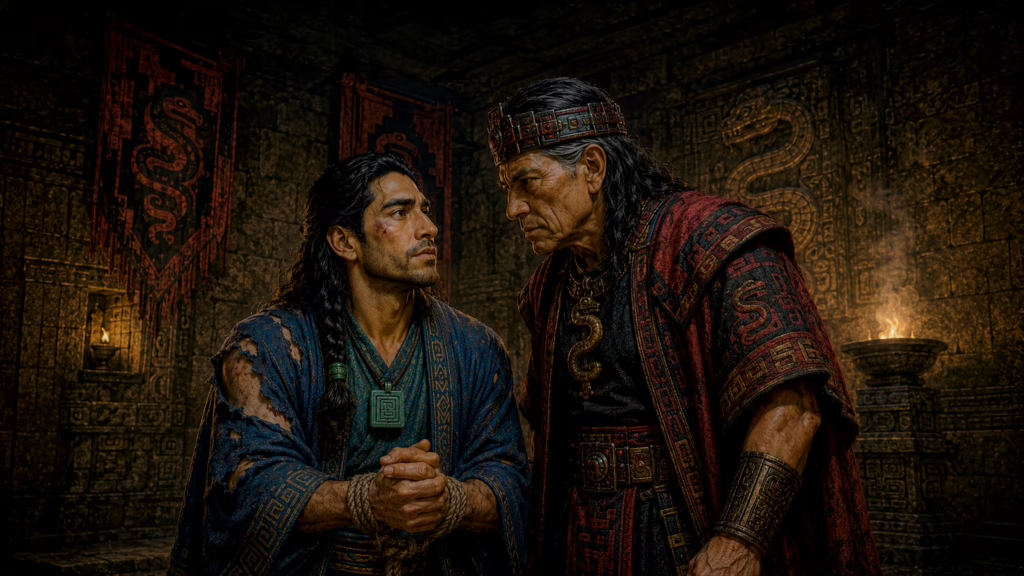
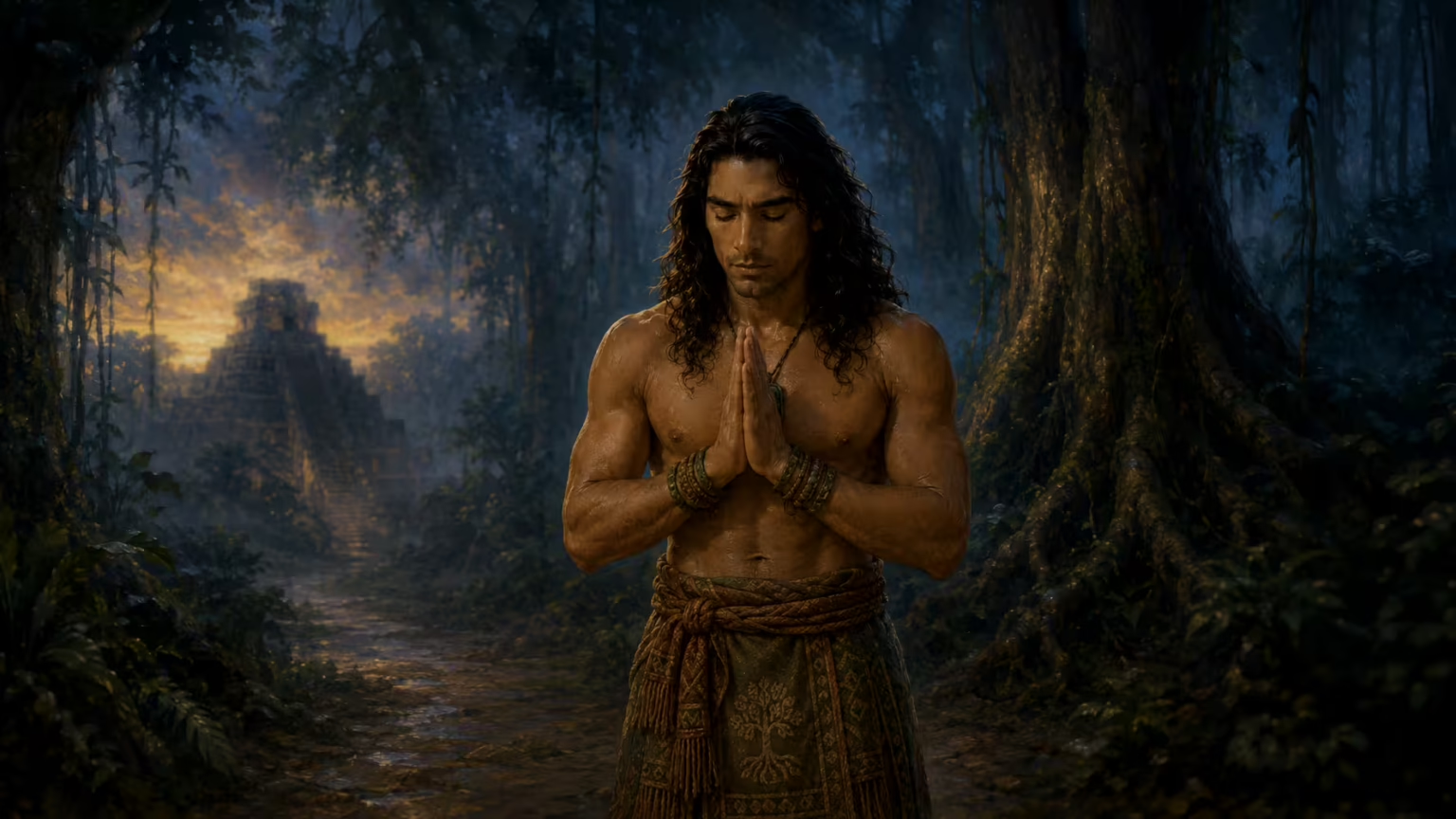
Ah’Chaan, a scholar of resonance and a keeper of sacred knowledge, is captured by King Zinalan of Valoria. Zinalan wants him to reveal how to command the Lumina’s flow. Ah’Chaan is bound. Wounded. Threatened. His family is at risk. The power before him is not symbolic; it is immediate, physical, and cruel. He has every reason to surrender. But he does not.
“Control is an illusion,” Ah’Chaan says. “You think you can dominate the Lumina, but you will only break yourself against it.”
Then, when Zinalan threatens his family, Ah’Chaan answers with the line that carries the moral center of Aurelda’s sacred dissent:
“You can hurt me. You can threaten my family. But I will not betray the Lumina. Its flow will endure, even if I do not.”
That is righteous dissent through the language of myth. Not rage for spectacle. Not rebellion for ego. Not the thrill of being against a king. It is the sacred refusal to betray what is life-giving.
Righteous Dissent and the Courage to Protect What Heals
The reason this scene matters is not because Ah’Chaan is invulnerable. He is not. His courage hurts. His refusal has consequences. The scene lands because he is afraid, and still aligned. That is the part many stories get wrong about courage.
Courage is not the absence of fear. It is the presence of something more important than fear.
For Ah’Chaan, that something is the Lumina. It is the living current that binds the world together. To hand it over to domination would be to wound not only himself, but the future. That is why his dissent feels sacred. And that is why it speaks to the present.
Because the central question is not limited to Aurelda. It is everywhere.
- What happens when technology meant to connect us becomes a tool of surveillance?
- What happens when medicine becomes inaccessible to those who need it most?
- What happens when land, water, culture, story, body, labor, and memory are treated as resources to be extracted?
- What happens when truth itself is pressured to kneel?
At some point, every generation has to answer. Do we cooperate with the misuse of what heals? Or do we refuse?
Dissent as Patriotism, Dissent as Love

One reason righteous dissent is so often misunderstood is that people confuse dissent with hatred. But many of history’s most courageous dissenters were not acting because they hated their communities. They acted because they could still imagine those communities becoming more whole.
The suffrage movement offers another example. The National Archives describes generations of women’s suffrage supporters who “lectured, wrote, marched, lobbied, and practiced civil disobedience” to secure the right to vote.⁶ What looks obvious in hindsight was once treated as radical, improper, destabilizing, even dangerous.
That is one of history’s recurring patterns. Many acts of conscience are condemned before they are remembered as courage.
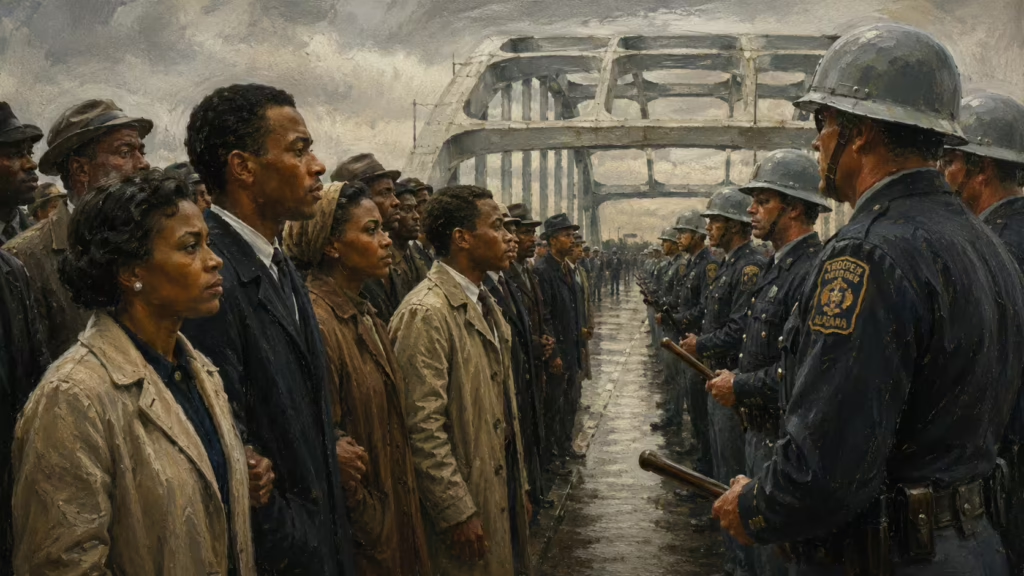
The same was true of the Selma marches in 1965, organized to protest the systematic blocking of Black Americans’ right to vote in the Jim Crow South. The National Archives describes those marches as a watershed that helped lead to the Voting Rights Act of 1965.⁷ Today, the images are part of the moral memory of the United States. At the time, the marchers faced violence for demanding rights already promised in principle.
That is righteous dissent. Not because it was polite. Not because everyone agreed. But because it exposed the distance between a society’s stated values and its lived reality.
Resonant Dissent: A Mythic Word for a Human Choice

In Aurelda, I might call this resonant dissent. Resonant dissent is what happens when the “no” comes from alignment, not contempt. It does not seek destruction first. It seeks restoration. It does not confuse domination with strength. It does not confuse silence with peace. It listens for the deeper current.
That is why Ah’Chaan’s refusal matters. He is not simply opposing Zinalan. He is staying faithful to the Lumina. His dissent is anchored in relationship — to the land, to his family, to the future, to the sacred flow he knows cannot survive if it is treated as a weapon.
And maybe that is the medicine the phrase “righteous dissent” needs right now.
Not more noise. More rootedness.
Not more certainty. More conscience.
Not another way to divide ourselves into the righteous and the condemned. Rather, a deeper question:
What are we protecting, and is it truly life-giving?
Begin a Hero’s Journey of Sacred Remembrance
Enter the world of Aurelda through The Prophecy of Resonance, Book One of The Aurelda Chronicles. Begin the journey with free sample chapters of Book 1.
Outside Aurelda
- NYC Mayor’s Office, “Remarks as Prepared: Mayor Mamdani Delivers Address Marking America’s 250th Birthday,” July 3, 2026.
- “Zohran Mamdani rebukes Trumpism with pro-immigrant speech for US’s 250th birthday,” The Guardian, coverage of Mamdani’s America 250 speech and its contrast with Trump-era nationalist framing.
- Monticello, “Dissent is the highest form of patriotism” spurious quotation entry.
- National Park Service, “What is the Underground Railroad?”
- United States Holocaust Memorial Museum, “Pamphlet Distributed by the White Rose Movement.”
- National Archives, “Woman Suffrage and the 19th Amendment.”
- National Archives, “Selma Marches.”
Where Will You Go From Here?
Comment Below
Share the Love
Share this article with kindred spirits.
Jason Samadhi

Begin the Hero’s Journey
Enter the world of Aurelda through The Prophecy of Resonance, Book One of The Aurelda Chronicles. Begin the journey with free sample chapters of Book 1.
Listen & Re-member
Aurelda Soul blends mythic storytelling, sacred wisdom, and grounded reflection for modern seekers finding their way home.
Find Your Thread
The Seven Threads Protocol helps you name your pattern, reconnect breath, body, and story, and begin a grounded path back to your own remembering with clarity. Download the free Seven Threads of Light Protocol guide now.
