
The Visible Thread: What I Learned About Myself on My 50th Birthday
Tracing ancestry on my 50th birthday led me through Quakers, textile workers, teachers, miners, queerness, belonging, and visibility.
This post may contain affiliate links; your purchases help earn me a small commission at no extra cost, supporting the art and continued growth of Aurelda.
This was not the 50th birthday celebration I imagined. I don’t know exactly what I expected. Maybe something softer. Maybe a little more ease. Maybe a sense of arrival, or at least a day that didn’t ask so many questions. Instead, I found myself sitting with family names, public records, old places, ancestral threads, and a surprising amount of ache.
At first, it felt like simple curiosity. Who were these people? Where did they come from? What did they do? What kind of lives did they live? But family history has a way of refusing to stay simple.
The names began to gather into patterns. On one side, there were Quakers, clothiers, textile workers, ministers, and people who appear in old Yorkshire records. People from Rawdon, Guiseley, and the northern English textile world. People who likely lived modestly, worked with their hands, and knew what it meant to survive through craft, discipline, faith, and stubbornness.
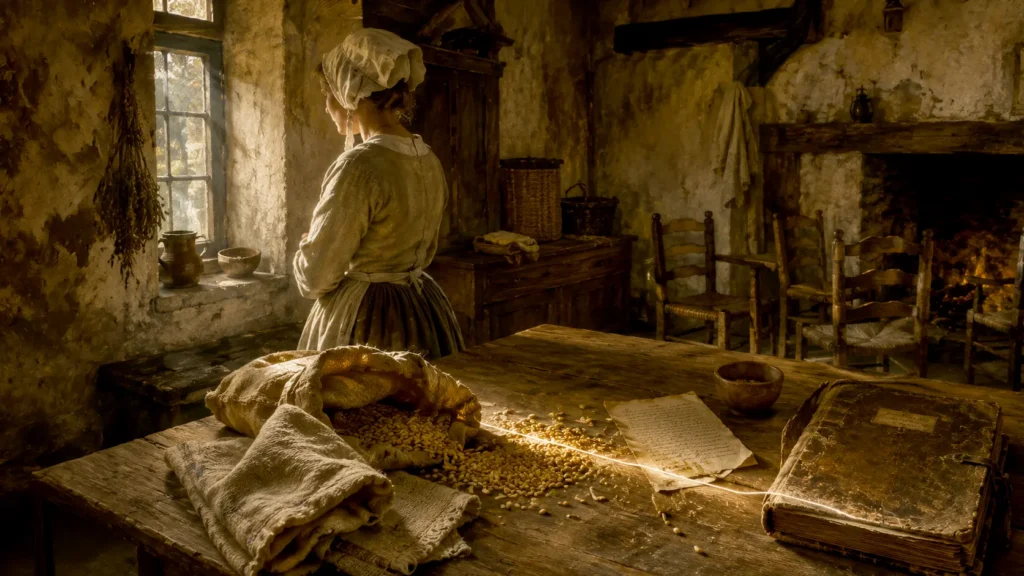
One ancestor, Sarah, became a Quaker. Records suggest her grain was seized because she refused to pay church tithes. Her home later became a registered place for Quaker meetings. That stopped me. This was not abstract spirituality. This was conscience with consequences.
Then there were ministers and early anti-slavery connections in New York. People who stood in uncomfortable rooms before certain moral positions became safe or socially convenient. Again, not saints. I am not interested in turning ancestors into flawless icons. But there is a thread there: a refusal to simply go along when the official story does not match the inner one.
And then, almost unexpectedly, the textile line hit me personally. My grandmother, Nana, quilted.
That might have seemed like a sweet family detail before. But after seeing the longer line of cloth, textile work, and making, it felt different. Not proof of destiny. Not some neat ancestral equation. But a kind of echo. Cloth becoming memory. Pieces joined into pattern. Fragments made warm. A family language continuing long after anyone remembered where it began.
On the Moore side, another current appeared: the Sloats, New York, California history, mining country, education, movement. My great-grandmother Helen Sloat appears to have been educated and a teacher. Family memory says she met Hibbard Moore on a boat going to Puerto Rico. He may have come through New Mexico mining country, Colorado School of Mines, and World War I.
That story is not fully proven yet, but even as a fragment, it carries atmosphere: a teacher, a mining man, a boat, Puerto Rico, California, children, and a family line moving westward.
So here I am, on my 50th birthday, looking at a tree of makers, dissenters, teachers, ministers, migrants, and practical people who crossed thresholds. And then the difficult part came.
Because line after line in genealogy is recorded through marriages, fathers, mothers, children, land, church, military, census, birth, and death. The archive is built around what society knew how to record.
And I found myself wondering: Where am I in this? Where is the queer thread? It suddenly felt like I might be the only one. That hit harder than I expected.
Not because I actually believe I am the only queer person who ever existed in my family line. I don’t. Queer people have always existed. But records rarely preserved us honestly. They preserved husbands and wives. They preserved inheritance. They preserved socially acceptable households. They did not preserve longing, secrecy, chosen family, hidden tenderness, coded devotion, or the people who folded themselves into silence in order to survive.
So maybe I am not the only queer thread. Maybe I am one of the first visible ones. That is both beautiful and lonely.
Being visible is not the same as being held. Sometimes visibility feels like standing at the edge of a very old woven cloth and realizing you are a color no one wrote down before. Not because the color was absent, but because no one was allowed to name it. And maybe that is why the day hurt.
I was not just researching ancestors. I was asking whether they would have recognized me. Whether they would have made room for me. Whether my life is a continuation, a rupture, or both. Indeed, the answer I keep coming back to is: both.
I belong to them, but I am not confined by them. I come from them, but I am also becoming something they may not have been able to imagine. That is a strange inheritance to carry.
What I saw reflected back to me today was not that I come from famous people, though there may be a few historically interesting threads. It was not that I come from wealth or nobility. The picture was humbler and, honestly, more meaningful.
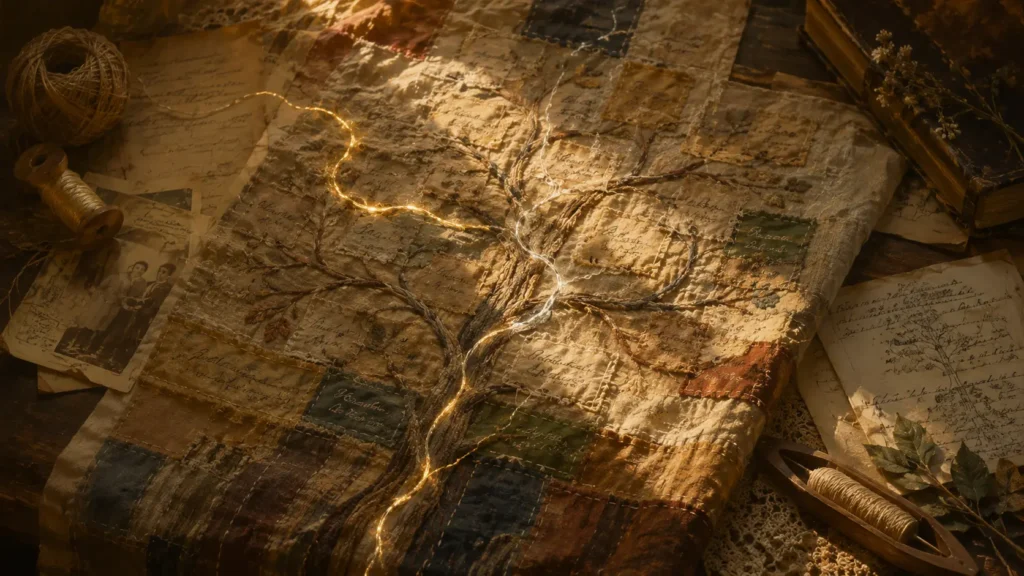
I come from patterned people. People of cloth. People of conscience. People of crossing. People who worked, taught, preached, migrated, repaired, endured, and made do. People who lived close enough to pressure that they had to become resourceful. People who were not always powerful, but were persistent. And maybe that explains something about me.
Maybe this is why I have spent so much of my life trying to join things that other people keep separate: story and healing, breath and technology, queerness and sacredness, grief and beauty, family history and myth, practical systems and spiritual remembering.
Maybe my sensitivity is not a flaw in the design. Maybe it is part of the instrument.
I feel things deeply because I listen for pattern. A name becomes a room. A date becomes a weather system. A family trade becomes a symbol. A grandmother’s quilt becomes a centuries-long conversation with cloth. A Quaker woman losing grain becomes spiritual defiance. A teacher on a boat becomes a doorway into a life I never knew.
That kind of sensitivity is not always easy to live with. Some days, it feels like too much. Some birthdays, apparently, it cracks the whole room open. But tonight, with the day almost over, I am trying to let this be enough:
- I made it to fifty.
- I am still here.
- I am still tender.
- I am still creating.
- I am still asking where I come from, not because I am lost, but because some part of me knows the map is bigger than what I was handed.
If I am the visible queer thread in this family line, then maybe my task is not to prove I belong. Maybe my task is to let the thread shine. Not only for myself, but for the hidden ones. The unnamed ones. The ones who lived before language, before safety, before permission.
Maybe I am not outside the family cloth. Maybe I am the part of the pattern that was waiting for enough light.
Begin a Hero’s Journey of Sacred Remembrance
Enter the world of Aurelda through The Prophecy of Resonance, Book One of The Aurelda Chronicles. Begin the journey with free sample chapters of Book 1.
Where Will You Go From Here?
Comment Below
Share the Love
Share this article with kindred spirits.
Jason Samadhi

Begin the Hero’s Journey
Enter the world of Aurelda through The Prophecy of Resonance, Book One of The Aurelda Chronicles. Begin the journey with free sample chapters of Book 1.
Listen & Re-member
Aurelda Soul blends mythic storytelling, sacred wisdom, and grounded reflection for modern seekers finding their way home.
Find Your Thread
The Seven Threads Protocol helps you name your pattern, reconnect breath, body, and story, and begin a grounded path back to your own remembering with clarity. Download the free Seven Threads of Light Protocol guide now.
