


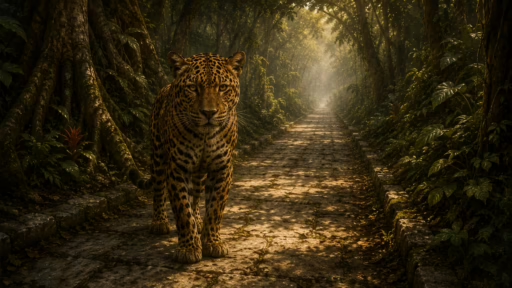
Some animals arrive in the inner world like messengers. A wingbeat in the dark. A pawprint at the edge of a dream. A pair of watchful eyes appearing when your own vision feels clouded. You do not need to force a name onto that presence. You begin by listening.
That is the heart of this animal spirit guide meditation. It is not a claim that you can take a sacred teaching from another culture and make it your own. It is an invitation into symbolic listening, grounded imagination, and respectful relationship with the more-than-human world.
In Aurelda, guidance rarely arrives as a command. It comes as a shimmer in the Lumina, a silence that suddenly feels alive, a presence that helps the seeker remember what the mind has forgotten. Chimalmat, Mo’an’s owl nahual, carries that medicine with quiet precision. He does not force revelation. He waits until the soul is ready to see.
Why This Practice Needs Respect
The phrase “spirit animal” has been widely popularized in modern wellness and internet culture, often in ways that flatten or trivialize Indigenous relationships with animals. Many Native American nations hold specific teachings about animals, kinship, clans, stories, and place. Those teachings are not generic symbols for anyone to adopt at will.
The jaguar symbolism essay offers a closer look at one animal, while keeping personal interpretation distinct from cultural authority.
A respectful animal spirit guide meditation must begin with humility. It should not pretend to reproduce Native American ceremony, Maya ritual, Nahua practice, or any living Indigenous tradition. It should not claim that every culture believes the same thing about animal guides. It should not turn sacred relationships into personality quizzes, trends, or aesthetic branding.
Aurelda walks a different path. It is a Maya-inspired visionary world, not a retelling of Maya religion or a substitute for Indigenous knowledge. Its nahuals are original beings within the Aureldian mythos, shaped by reverence for Mesoamerican cosmologies while remaining part of a fictional universe. That distinction protects the sanctity of the sources and the integrity of the story.
Nahual Does Not Mean One Simple Thing

The word nahual carries deep and complex histories. In some Mesoamerican contexts, related ideas involve a bond between a person and an animal companion. In others, nahualism is connected to transformation, power, sorcery, healing, social authority, protection, or danger. Among Maya studies, the concept of way or wayob is sometimes discussed as an animal-like co-essence or spiritual force, but even there the meaning is layered and not always gentle.
This matters because the modern seeker may want a simple answer: “What is my animal guide?” The older traditions do not always offer simplicity. They offer relationship, responsibility, and ambiguity. They ask the human being to remember that animals are not decorations for the self. They are lives, presences, forces, kin, symbols, and sometimes mirrors that reveal what the ego would rather avoid.
So in this meditation, you are not claiming ownership over a nahual in the historical sense. You are entering an Aureldian practice of symbolic encounter. You are asking what animal presence may help you listen more honestly to your body, your fear, your courage, your grief, and your path.
What Guided Imagery Can Actually Do

Guided meditation and guided imagery do not prove that a guide is externally real. They also do not need to. Their value often begins with the way imagination speaks to the nervous system. A visual image, sound, felt sense, or inner landscape can help focus attention, soften stress, and give emotional shape to something that has been difficult to name.
Research on meditation and guided imagery suggests that these practices may support relaxation, anxiety reduction, and emotional regulation for some people, though they are not risk-free for everyone and should not be treated as medical care. The most honest approach is both open and grounded. Let the image arrive. Let the body respond. Keep discernment close.
If an owl appears, listen. If a jaguar appears, listen. If no animal appears, listen to that too. Absence can be a guide when it teaches you patience. Stillness can be a threshold when it asks you to stop performing spirituality and simply be present.
Chimalmat as an Imaginative Companion
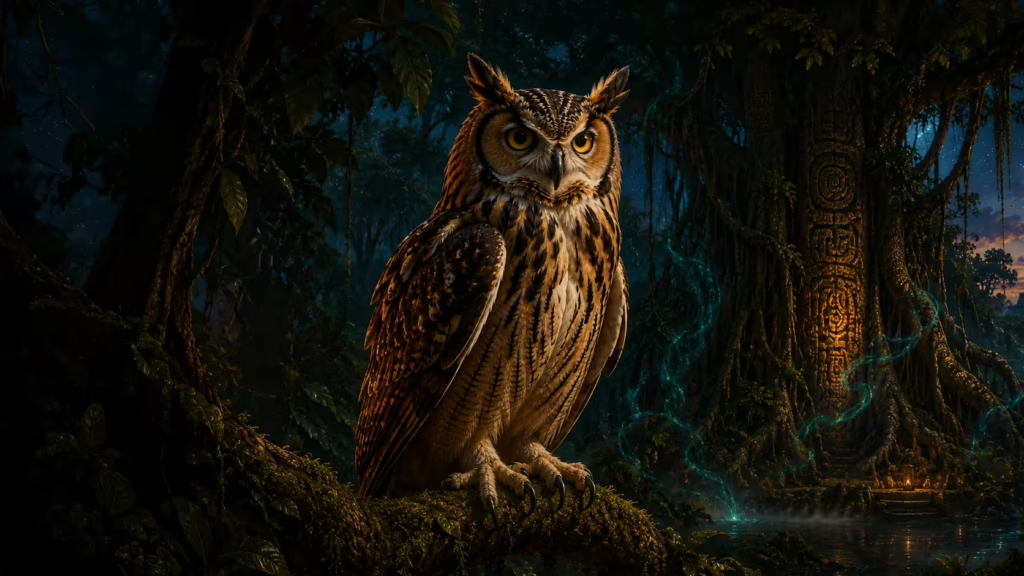
Chimalmat is an owl figure in Aurelda’s fiction. The image can invite attention to what is difficult to name, without giving the listener instructions or claiming ownership of a living cultural practice. Treat your response as interpretation, not evidence of a supernatural message.
The cosmic tree recording offers one contemporary creative treatment of that imagery.
How to Enter the Meditation

Before beginning an animal spirit guide meditation, choose a quiet place where your body can feel reasonably safe. Let your breath lengthen without forcing it. Notice the contact between your body and the surface beneath you. Let the world become simple for a moment.
You might imagine yourself standing at the edge of a cenote, beneath the shade of a Ceiba, or on a moonlit path where the forest seems to listen back. Do not rush to summon an animal. Invitation is different from demand. Ask inwardly, “What presence may help me remember what I am ready to know?”
Then wait. You may sense movement before you see anything. You may hear wings, water, paws, breath, or silence. You may feel warmth in the chest, a tightening in the belly, or an unexpected emotion rising. Let the experience unfold as symbol, not proof. The purpose is not to collect a guide. The purpose is to become more available to guidance.
Questions to Ask Your Animal Guide
If an animal presence appears, meet it with respect. You can ask simple questions and notice what changes in the body as you ask them:
- What are you helping me see?
- What part of me have I ignored?
- What strength am I ready to reclaim?
- What fear needs tenderness instead of force?
- What does my next step feel like in the body?
Do not worry if the answers do not arrive as words. Some guidance comes as color, pressure, memory, posture, emotion, image, or a sudden sense of enoughness. Chimalmat often teaches through presence more than speech. The deeper guide may do the same.
For Unseen Seekers and Queer Spiritual Wanderers
Many unseen seekers come to meditation carrying old spiritual exclusion. Some were told their body could not be trusted. Some were taught that their queerness, sensitivity, longing, intuition, or tenderness placed them outside the sacred. That kind of exile can make the inner world feel dangerous, even when it is calling you home.
An animal spirit guide meditation can become a gentle way back into relationship. Not because an animal symbol fixes the wound, but because symbolic encounter can help the body feel witnessed. A guide in the shape of an owl, deer, serpent, jaguar, dog, hummingbird, or creature unknown may reveal a quality that has been waiting for permission to return.
For the queer spiritual seeker, this can be especially meaningful. The animal world is full of variation, adaptation, beauty, instinct, care, and forms of relationship that do not always obey rigid human categories. Nature does not need your soul to become smaller before it belongs.
Let the Guide Remain Alive
A true guide is not a label. It is a relationship that changes as you change. The animal who appears once may never appear again. Another may come in a season of grief, protection, courage, rest, or release. The point is not to secure an identity. The point is to keep listening.
In Aurelda, the Lumina moves through relationship. It is not something to possess. It is something to honor. When Chimalmat appears, he does not make Mo’an dependent. He helps him remember that guidance is already moving through the weave of breath, body, memory, land, and choice.
Enter the meditation with that same humility. Let the animal be more than a symbol and less than a possession. Let it remain mysterious enough to stay alive.
Returning from the Threshold
When the meditation ends, place a hand on your heart, belly, or the ground. Thank whatever appeared, even if what appeared was silence. Write down what you remember before the mind edits it into something more acceptable.
Then ask what the guidance wants from your life, not only from your imagination:
- Does it ask you to rest?
- To speak?
- To protect your tenderness?
- To move slowly?
- To stop abandoning your body?
- To seek the next thread in the story?
Aurelda does not ask you to escape the world. It asks you to return with more of yourself intact. The guide at the threshold is not there to make you extraordinary. The guide is there to help you remember what has been quietly faithful within you all along.