
Sacbé
This entry may contain affiliate links; your purchases help earn me a small commission at no extra cost, supporting the art and continued growth of Aurelda.
More About 'Sacbé'
The Sacbé is the road that remembers why it was built.
In Aurelda, a Sacbé is more than a pathway between cities. It is a line of trust made visible in stone, lime, light, and vow. To walk it is to enter a current of memory laid across the land by those who believed that peace must become more than an idea. It must have a road beneath the feet.
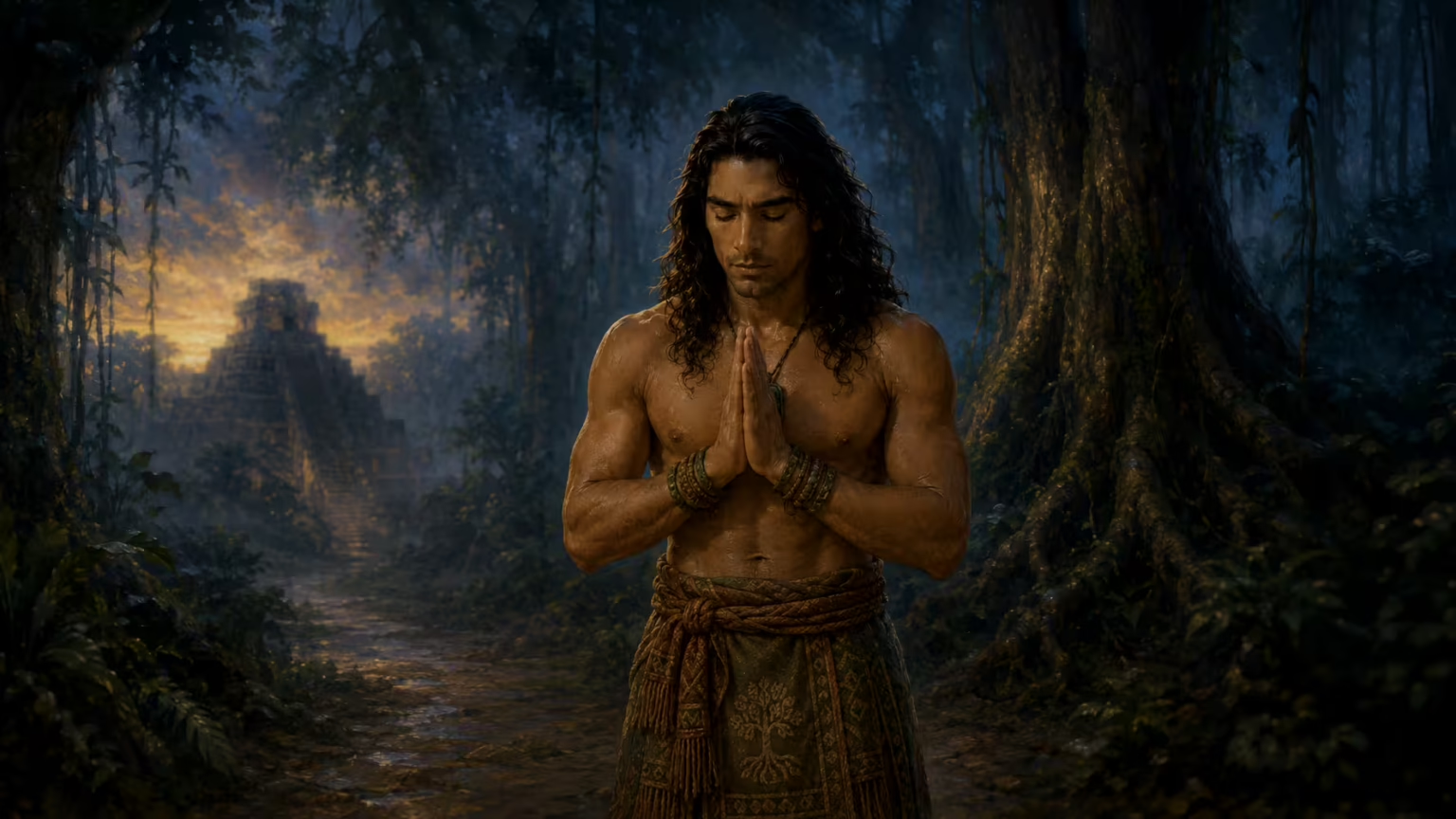
What Are Maya White Roads? In the real world, the phrase points toward ancient Maya sacbeob, raised white causeways often made with limestone and used to connect ceremonial centers, sacred places, settlements, and political landscapes. In Aurelda, the Sacbé carries that historical echo into myth. It becomes a luminous road of return, a sacred route where memory, alliance, and spiritual direction converge.
The first Sacbé of Aurelda was built during the Silver Age, when the realm was still learning how to live after fracture. It connected Elaron and Solara, joining the city of scholars and memory with the city of spiritual sanctuary. This road was not only practical. It was ceremonial architecture, a public promise that wisdom and devotion would continue to recognize one another.
The Elaronian scholars measured the route with reverence, reading terrain, light, and resonance as parts of one living map. Solaran elders blessed the work as an act of relationship. When the white surface was completed, it was said to glow softly beneath moonlight, not because it was trying to command the Lumina, but because the land had accepted the intention placed upon it.
For generations, this road stood as a visible sign of trust between two city-states. Travelers walked it for diplomacy, pilgrimage, study, healing, and return. Messengers carried news along it. Elders crossed it to attend council. Seekers followed it when they needed to remember that home could be reached by steady steps.
The next major Sacbé was not built until the end of the Golden Age, during the time of Queen Ix’Kan. This second great road connected Solara and Valoria. Its meaning was different from the first. Where the Elaron-Solara road marked kinship and shared wisdom, the Solara-Valoria Sacbé was built as a sign of trust and amnesty. It did not erase the wounds between the city-states. It gave them a way to walk toward each other without pretending the past had not happened.
By this period, the Sacbé of Aurelda had begun to reveal a deeper pattern. The roads connected Elaron, Solara, and Valoria to one another and to the Resonance Station, forming a near-perfect triangle across the living lay lines of Aurelda. In the hands of Elaronian scholars, road-building became sacred geometry. In the hands of Solaran elders, it became prayer. In the hands of Valorian leaders willing to enter peace, it became a test of humility.
Together, the Sacbé became part of the great reweaving. They helped transform movement itself into remembrance, preparing the realm for an age in which connection could no longer be held only in temples, archives, or royal vows. It had to be walked.
Key Significance / Role
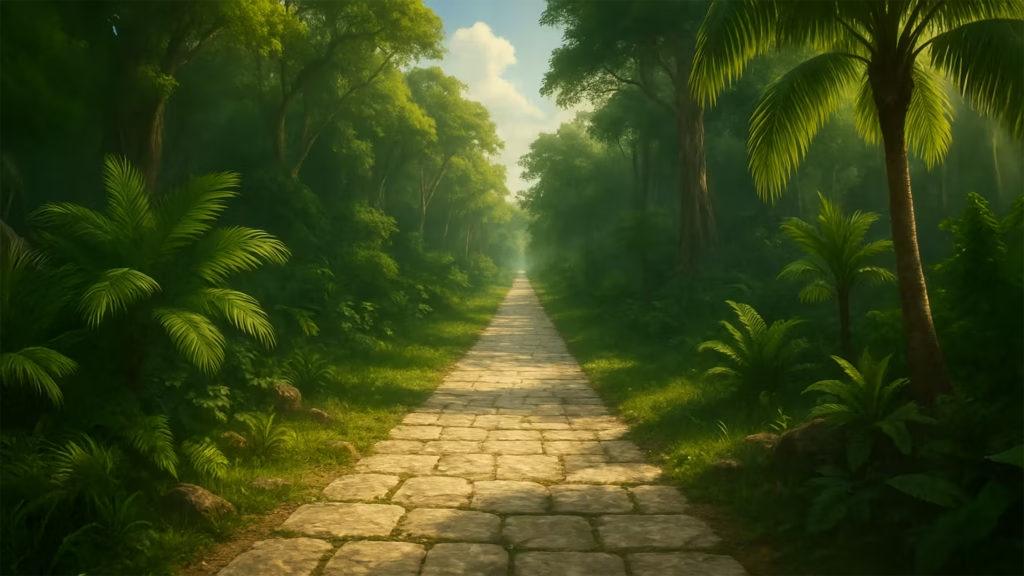
A Sacbé in Aurelda appears as a raised white road, broad enough for travelers, processions, council parties, and ceremonial crossings. Its surface is pale limestone, burnished by hands, feet, weather, and moonlight. In daylight, it gleams with a soft, sun-warmed brightness. At night, it can appear almost silver, especially where the Lumina runs close beneath the earth.
The edges are often bordered by low stones carved with simple glyphs of trust, return, balance, and shared memory. In older stretches, roots from nearby ceiba trees may press against the retaining stones without breaking them, as if the living world is holding the road in place. Small wayside markers stand at intervals, offering water, shade, and quiet places for reflection.
A Sacbé is not built to dominate the land. It follows the land’s listening. Even when it seems mathematically precise from above, the road bends where the jungle, cenotes, ridges, or sacred groves require respect. Its geometry is not cold. It is relational.
The oldest Elaron–Solara Sacbé carries a quieter presence, lined with scholar stones, prayer niches, and worn resting places where generations paused beneath the trees. The Solara-Valoria Sacbé feels more ceremonial and exposed. Its whiteness carries the tension of amnesty, a reminder that peace is not the absence of memory, but the choice to walk with memory differently.
Where the roads approach the Resonance Station, the stonework becomes more intricate. Patterns of triangles, spirals, and wave lines appear in the paving. They are not decoration. They help attune the body to the larger geometry of the realm, guiding the traveler from ordinary movement into sacred awareness.
Inspiration Notes
The Sacbé is Aureldian lore, inspired by ancient Maya sacbeob. The word is commonly understood through Yucatec Maya roots meaning “white road,” and archaeologists use sacbeob to describe raised causeways found throughout the Maya world.
Real-world sacbeob were not all the same. Some connected spaces within ceremonial centers. Others linked distant settlements or cities. Their functions could be practical, political, economic, ritual, and symbolic at once. Research at Caracol, Belize, shows that causeways helped organize movement, administration, communication, and integration across a large urban landscape. Other scholarship emphasizes their ritual and cosmological roles, especially as procession routes and sacred connectors.
One famous example is the long Cobá-Yaxuná road in the Yucatán Peninsula. Modern LiDAR research has shown that this white road was not a perfectly straight line as once believed, but a route that moved through smaller settlements along the way. Its limestone surface reflected ambient light, making it visible at night. That image deeply resonates with Aurelda’s Sacbé: a pale road made visible in darkness.
Archaeological writing also invites a more relational reading of Maya roads. Recent work on a Punta Laguna sak-be interprets some Maya roads as active connectors that continue to hold meaning, linking places, human beings, other-than-human beings, and temporalities. This does not make Aurelda a retelling of Maya belief. It simply shows why roads can carry more than traffic. They can carry memory.
The Sacbé’s connection to Aurelda’s lay lines and sacred geometry should be understood as in-world metaphysics. In real-world research, ley lines are a modern theoretical and New Age idea first associated with Alfred Watkins in the early twentieth century, and they are not accepted as archaeological fact by academic archaeologists. Aurelda transforms the image of aligned sacred routes into its own mythic law: the land has lines of resonance, and roads built with reverence can help the realm remember how to connect.
Work Cited
- “The Aurelda World Map.” Author: Jason Samadhi / Aurelda Press.
- “Resonance Station.” Author: Jason Samadhi / Aurelda Press.
- “Resonance Network.” Author: Jason Samadhi / Aurelda Press.
- “Cultura Maya.” Author: Instituto Nacional de Antropología e Historia. Original date posted: not listed. URL:
- “Did a Seventh-Century Warrior Queen Build the Maya’s Longest Road?” Author: Theresa Machemer. Original date posted: March 6, 2020.
- “Ancient Maya Causeways and Site Organization at Caracol, Belize.” Authors: Arlen F. Chase and Diane Z. Chase. Original date posted: 2001.
- “Maya Roads as Kuxansumob: Analyzing an Intrasite Sak-Be Assemblage at Punta Laguna, Yucatán, Mexico.” Authors: Nicholas A. Puente and Sarah Kurnick. Original date posted: November 21, 2025.
- “Las calzadas mayas.” Author: Traci Ardren. Original date posted: not listed on page.
- “Procesiones y sacbeob de las Tierras Bajas del norte en el Clásico maya.” Author: Traci Ardren. Original date posted: 2015, according to bibliographic listing.
- “White Roads of the Yucatán: Changing Social Landscapes of the Yucatec Maya.” Author: Justine M. Shaw. Original date posted: 2008.
- “Ley Lines.” Author: Isabel Brodsky, fact-checked by Encyclopaedia Britannica Editors. Original date posted: May 1, 2026.
Where Will You Go From Here?
Comment Below
Share the Love
Share this article with kindred spirits.
Begin the Hero’s Journey of Sacred Remembrance
Enter the world of Aurelda through The Prophecy of Resonance, Book One of The Aurelda Chronicles. Journey into Solara, where sacred light, prophecy, found family, and an unlikely Keeper converge as a world begins to lose its way. For a limited time, begin the trilogy with the direct-from-author eBook for $7.99.
Jason Samadhi
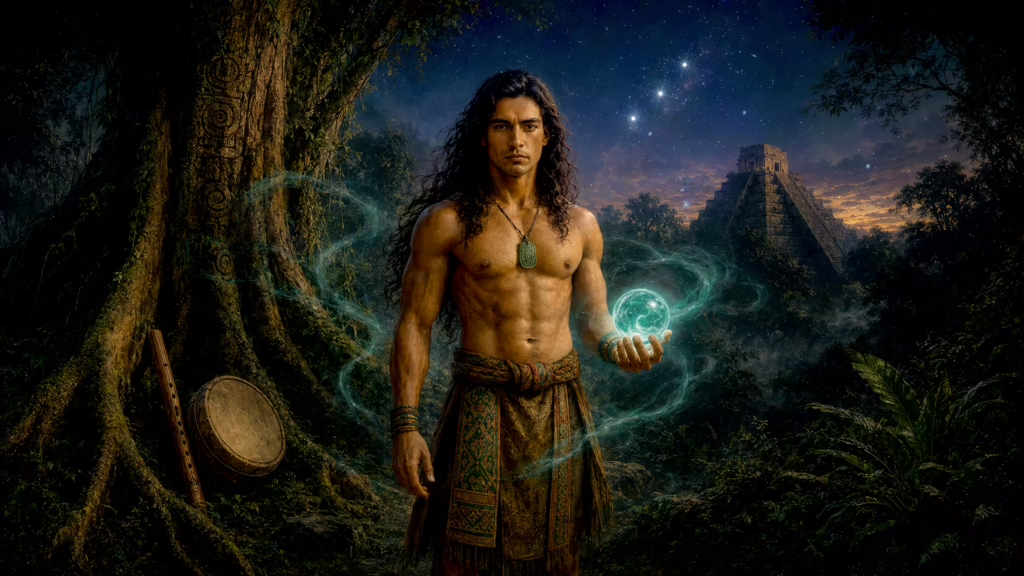
Begin the Hero’s Journey
Enter the world of Aurelda through The Prophecy of Resonance, Book One of The Aurelda Chronicles. Begin the journey with free sample chapters of Book 1.
Listen & Re-member
Aurelda Soul blends mythic storytelling, sacred wisdom, and grounded reflection for modern seekers finding their way home.
Find Your Thread
The Seven Threads Protocol helps you name your pattern, reconnect breath, body, and story, and begin a grounded path back to your own remembering with clarity. Download the free Seven Threads of Light Protocol guide now.
