
Healing Sexual Shame for Gay Men Through Sacred Sexuality
Healing Sexual Shame for Gay Men begins with sacred sexuality, story as medicine, and a gentle return to the body through Aurelda.
This post may contain affiliate links; your purchases help earn me a small commission at no extra cost, supporting the art and continued growth of Aurelda.
For many gay men, sexuality has been shaped by two opposing pressures: desire that rises naturally from the body, and shame that arrives from family, religion, culture, silence, or fear. The result can feel like an inner split. One part of you longs for touch, beauty, intimacy, and belonging. Another part tightens, apologizes, performs, or disappears.
Aurelda speaks to that split through sacred remembrance. Here, sacred sexuality is not performance, conquest, or spiritual language placed over old wounds. It is the patient return of dignity to the body. It is the practice of meeting desire with consent, presence, honesty, and reverence.
This post, Healing Sexual Shame for Gay Men, begins with a quieter question than most of us were taught to ask. What if the body is not the problem? What if the tenderness you learned to hide is not weakness, but one of the oldest doors back to your own soul?
What Sacred Sexuality Means Here

Sacred sexuality does not mean every desire becomes sacred simply because it feels intense. In Aurelda, the sacred is revealed through intention, care, coherence, and truth. Desire becomes healing when it stops being used to prove worth and begins to restore relationship: with the body, with the breath, with another person, and with the part of the self that was told it had to hide.
This matters for gay men because shame often teaches separation. You may have learned to separate sex from tenderness, masculinity from vulnerability, spirit from pleasure, or body from belonging. Sacred sexuality gathers those fragments back into conversation. It does not demand that you become more spiritual by becoming less human. It asks whether your humanity can be met as holy.
That question is not abstract. It lives in the nervous system, in the chest, in the throat, in the places where the body learned to brace before it learned to trust. Healing does not come from forcing those places open. It begins by listening.
Why Shame Becomes so Heavy

Modern research gives language to what many queer people know in their bones. Stigma, rejection, concealment, and internalized homophobia can create chronic stress. Shame can become more than an emotion. It can become a posture, a way of breathing, a way of approaching love as if it must first ask permission to exist.
Sexual shame can also distort desire. Some men move toward intensity because tenderness feels unsafe. Others shut down because wanting anything at all feels dangerous. Neither pattern is a moral failure. Both can be learned strategies for surviving a world that made the body feel watched, judged, or forbidden.
This is why sacred sexuality must be grounded in consent and care. Without consent, sexuality becomes extraction. Without care, spirituality becomes a costume. Without honesty, pleasure can become another place to hide.
Xōchipilli as a Careful Inspiration

The earlier version of this article centered Xōchipilli, often called the Flower Prince. That presence remains meaningful, but it must be held with precision. Xōchipilli belongs to Mexica and Nahua religious imagination, within the broader world often called Aztec. Credible museum and academic sources associate this deity with flowers, song, dance, beauty, fertility, sacred plants, and the life cycle.
Some modern queer and metaphysical readers see in Xōchipilli a symbol of sacred pleasure and same-sex love. That resonance can be powerful, especially for gay men seeking images of the divine that do not exile beauty, desire, or softness. Still, the responsible path is to name this as interpretation, not proof. We do not need to force the past to speak our exact modern language in order to receive medicine from its symbols.
Aurelda follows the same ethic. It does not retell Mexica religion. It does not claim to possess Indigenous ceremony. It receives inspiration through reverence and reimagines it inside a fictional, mythic realm where flowers, breath, beauty, and queer love become symbols of return.
From Colonial Shame to Embodied Remembrance

Colonial systems in New Spain punished same-sex acts through religious and civil structures that treated desire as sin, disorder, or crime. That history matters because shame is not only personal. It is inherited through law, sermons, silence, punishment, and the stories people are allowed to tell about their bodies.
To reclaim sacred sexuality is not to romanticize the past. It is to refuse the idea that colonial shame gets the final word. It is to remember that many cultures have held more complex relationships with gender, embodiment, ritual, and beauty than later authorities allowed. It is also to move carefully, without turning living Indigenous traditions into a mirror for modern longing.
The medicine is not appropriation. The medicine is respect, humility, and a renewed relationship with your own body.
Mo’an and Itzam’Yeh as Story as Medicine

In The Aurelda Chronicles, Mo’an and Itzam’Yeh offer a quiet medicine for gay men who have been taught to separate love from dignity. Their bond is not treated as a secret flaw or a side path. It is carried with reverence, restraint, and spiritual gravity. Publicly, their connection can appear through presence, loyalty, and subtle gestures of trust. Privately, it becomes a sacred field where tenderness is not weakness and desire is not shame.
This is story as medicine because it gives the reader a new image of masculine intimacy. Mo’an does not need to become hard to be holy. Itzam’Yeh does not need to deny tenderness to be strong. Their love teaches without preaching: the body can be a threshold, not an obstacle; longing can be a signal, not a sin; intimacy can be human and sacred at the same time.
No plot needs to be revealed for that medicine to work. The point is not to know everything that happens to them. The point is to feel what becomes possible when a story refuses to make queer love apologize for its radiance.
A Practice for Reading with the Body
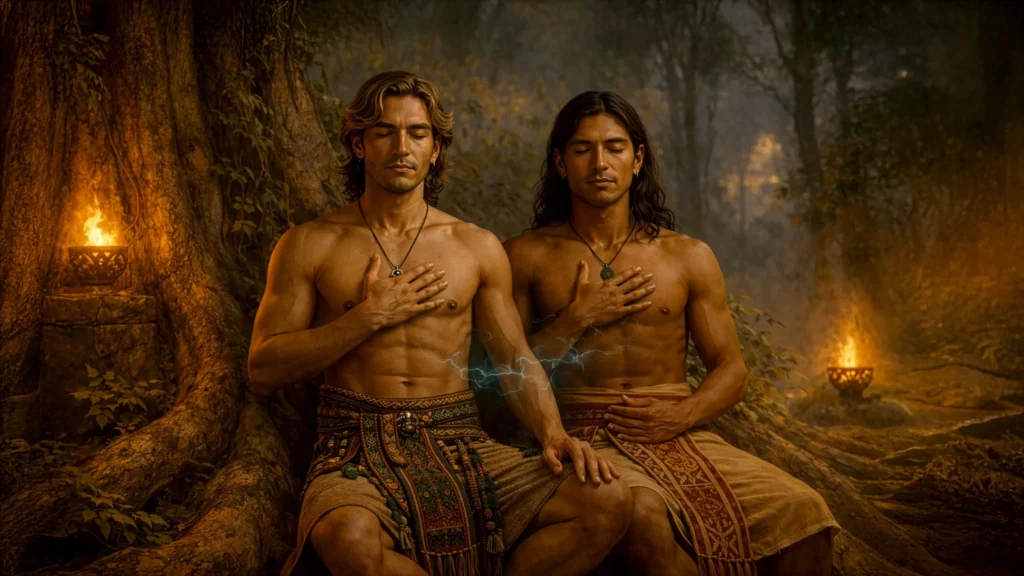
Before you read, pause and place one hand on your heart or lower belly. Let the breath arrive naturally. Ask, “Where have I learned to hide tenderness?” Then read one scene, one Codex entry, or one paragraph slowly enough to notice what your body does before your mind explains it.
If a sentence softens you, stay with it. If a symbol stirs grief, give it room. If resistance appears, do not fight it. Sometimes the part of you that resists sacredness is the part that was once punished for wanting it.
This is not therapy, and it is not a substitute for support when deeper care is needed. It is a small act of remembrance. It teaches the body that attention can be gentle.
Reclaiming the Sacred Without Losing the Human

Sacred sexuality for gay men does not need to become another impossible ideal. You do not need perfect confidence, perfect embodiment, or perfect spiritual language. You do not need to turn desire into doctrine. You only need to begin telling the truth with more mercy.
Maybe the truth is that you are tired of performing. Maybe it is that your body still expects judgment. Maybe it is that pleasure feels easier than love, or love feels safer when it stays imagined. Whatever the truth is, sacred remembrance begins when you stop exiling the part of you that carries it.
In The Book of Remembering, Aurelda offers a mythic language for that return. Xōchipilli’s floral resonance can remind you that beauty is not frivolous. Mo’an and Itzam’Yeh can remind you that masculine tenderness can be luminous. The Lumina can remind you that coherence is not control. It is the moment your body, breath, desire, and dignity begin to belong to the same story again.
If the part of you that once felt forbidden is actually the part that remembers, will you begin with the free field guide, Seven Threads of Light Protocol?
Works Cited
- Nesvig, M. (2008).The Sodomy Cases of Colonial Mexico: 1657–1699. In Sexuality and the Unnatural in Colonial Latin America. University of California Press.
- Báez, F. (2008).The Burning of the Books in New Spain. Atlas & Co.
- Joyce, R. A. (2001).Sex and Gender in Ancient Mesoamerica. Rowman & Littlefield Publishers.
- Laack, I. (2019).Aztec Religion and Art of Writing. Brill.
- Hill Boone, E. (2000).Stories in Red and Black: Pictorial Histories of the Aztecs and Mixtecs. University of Texas Press.
- Carvajal, F.G. (2003).Butterflies Will Burn: Prosecuting Sodomites in Early Modern Spain. University of Texas Press.
- “Urban Tantra: Sacred Sex for the Twenty-First Century” by Barbara Carrellas
- “Queer Dharma: Voices of Gay Buddhists” edited by Winston Leyland
- “Breathwork for Self-Transformation: Harness Your Vital Energy for Health and Happiness (Your Powerful Potential)” by Konstantinos Tselios
- AASECT. “Sacred Sexuality.” American Association of Sexuality Educators, Counselors and Therapists. Original date posted: November 3, 2024.
- BiblioVault. “Gender and Power in Prehispanic Mesoamerica.” Rosemary A. Joyce. Original publication date: 2001.
- Charon, Rita. “Narrative Medicine: A Model for Empathy, Reflection, Profession, and Trust.” JAMA. Original date posted: October 17, 2001.
- Cienfuegos-Szalay, J., Moody, R. L., Talan, A., Grov, C., and Rendina, H. J. “Sexual Shame and Emotion Dysregulation: Key Roles in the Association between Internalized Homonegativity and Sexual Compulsivity.” Journal of Sex Research. Original date posted: August 19, 2021.
- Google Arts & Culture and Museo Nacional de Antropología, México. “Xochipilli.” Arqlga. Bertina Olmedo Vera. Original date posted: not listed.
- Meyer, Ilan H. “Prejudice, Social Stress, and Mental Health in Lesbian, Gay, and Bisexual Populations: Conceptual Issues and Research Evidence.” Psychological Bulletin. Original date posted: September 2003.
- Museo Nacional de Antropología, INAH. “Xochipilli, el Señor de las Flores.” Original date posted: April 2018.
- Pachankis, John E., et al. “The Role of Shame in the Sexual-Orientation Disparity in Mental Health.” Original date posted: 2023.
- Rendina, H. Jonathon, López-Matos, Jonathan, Wang, Katie, Pachankis, John E., and Parsons, Jeffrey T. “The Role of Self-Conscious Emotions in the Sexual Health of Gay and Bisexual Men: Psychometric Properties and Theoretical Validation of the Sexual Shame and Pride Scale.” Journal of Sex Research. Original date posted: May to June 2019.
- Tortorici, Zeb, editor. “Sexuality and the Unnatural in Colonial Latin America.” University of California Press. Original publication date: 2016.
Updated: April 29, 2026
Where Will You Go From Here?
This journey is yours to continue. Choose your path:
Comment Below
Contribute to the story—share your thoughts below.
Share the Love
Share this article with kindred spirits.
Ready to Re-member Your True Self?
Receive updates on Aurelda books, journal entries, podcast episodes, breathwork events, and what’s unfolding next. Plus, get free sample chapters from The Aurelda Chronicles.
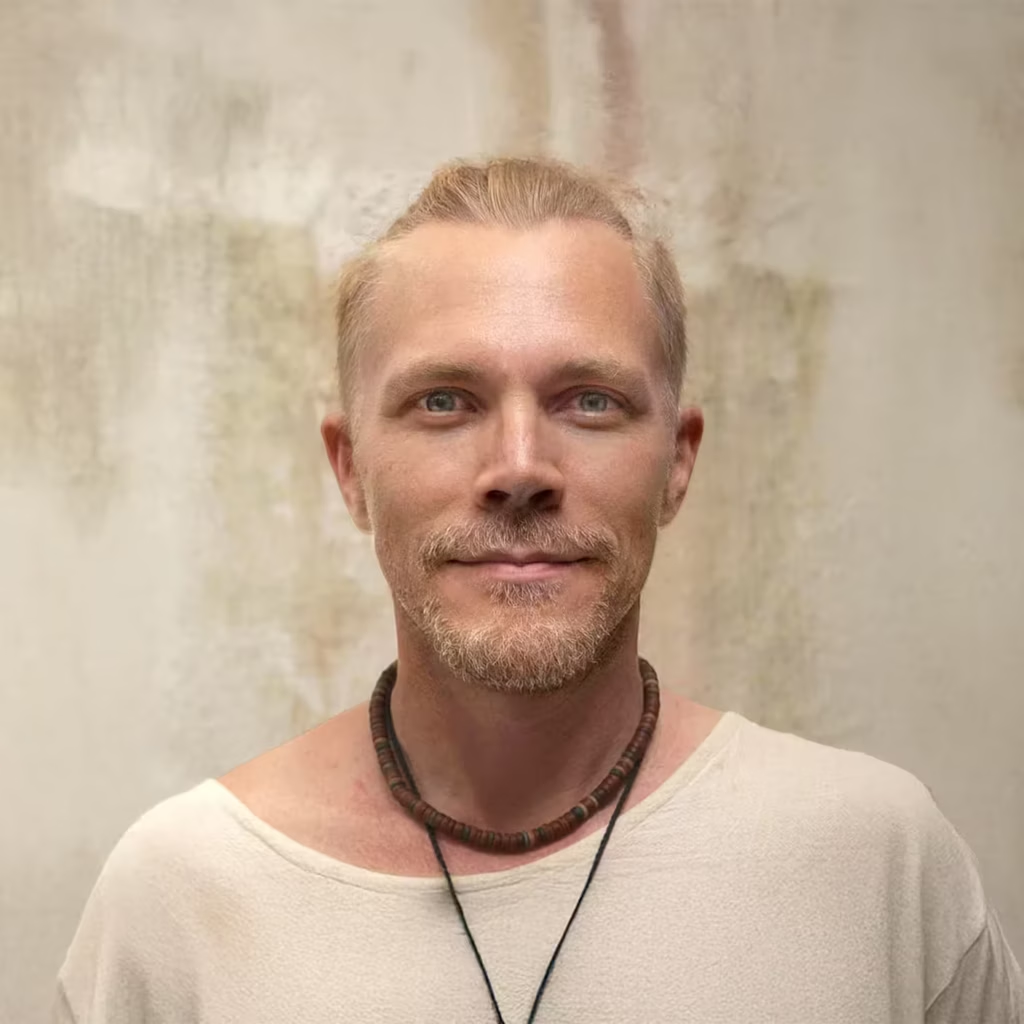
Jason Samadhi
Related Articles


Start Reading Aurelda
Get free sample chapters from all three books in The Aurelda Chronicles. A queer-affirming visionary fiction trilogy of love, loss, and transformation.
Listen & Re-member
Aurelda Soul blends mythic storytelling, sacred wisdom, and grounded reflection for modern seekers finding their way home.

Join the Inner Circle
Join a quiet, queer-affirming community as it grows around Aurelda, sacred remembrance, story, breath, and belonging.