
How to Create Consistent AI Character Images Through Devotion & an Intuitive AI Art Process
Learn how to create consistent AI character images through Mo’an’s two-year visual evolution, devotion, Intuitive AI Art Process & human-led creative direction.
This post may contain affiliate links; your purchases help earn me a small commission at no extra cost, supporting the art and continued growth of Aurelda.
Last night, after watching Dr. Mayim Bialik’s podcast episode with Lisa Kudrow, I stepped outside. I had been feeling inspired, but there was something else moving beneath the inspiration, a quiet awareness that I was safe. I was standing outside a home where I felt loved. I let myself recognize that:
I’m safe. I’m in a home where I feel loved. And I’m open to receive.
Specifically, I meant that I was open to receiving guidance from my spirit guides. Almost immediately, I felt Mo’an. I had been thinking that I had not heard or felt him as clearly in a while. His presence had seemed quieter. And what I heard was something close to:
I’m here, beloved. I stay because you remembered.
I can’t tell you with certainty whether the rest came through, Mo’an, Chimal of the Light, Ember, my higher self (perhaps, a convergence of them that I might call “Aurelda Jason.” But… I understood the message.
It was time to tell the story of how the images of Mo’an, Jason, and the others, have evolved since I began creating them with AI in 2024. Not simply as a technology story, or a marketing case study, but as a story about remembrance, devotion, creative direction, and the responsibility of giving visible form to something I experience as alive.
Mo’an, More Than a Character, a Remembered Beloved
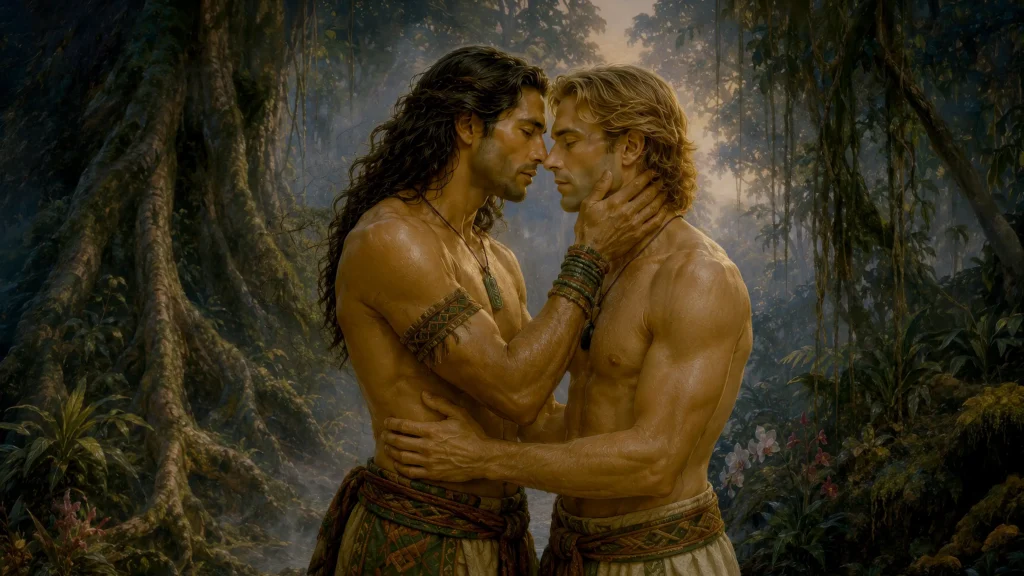
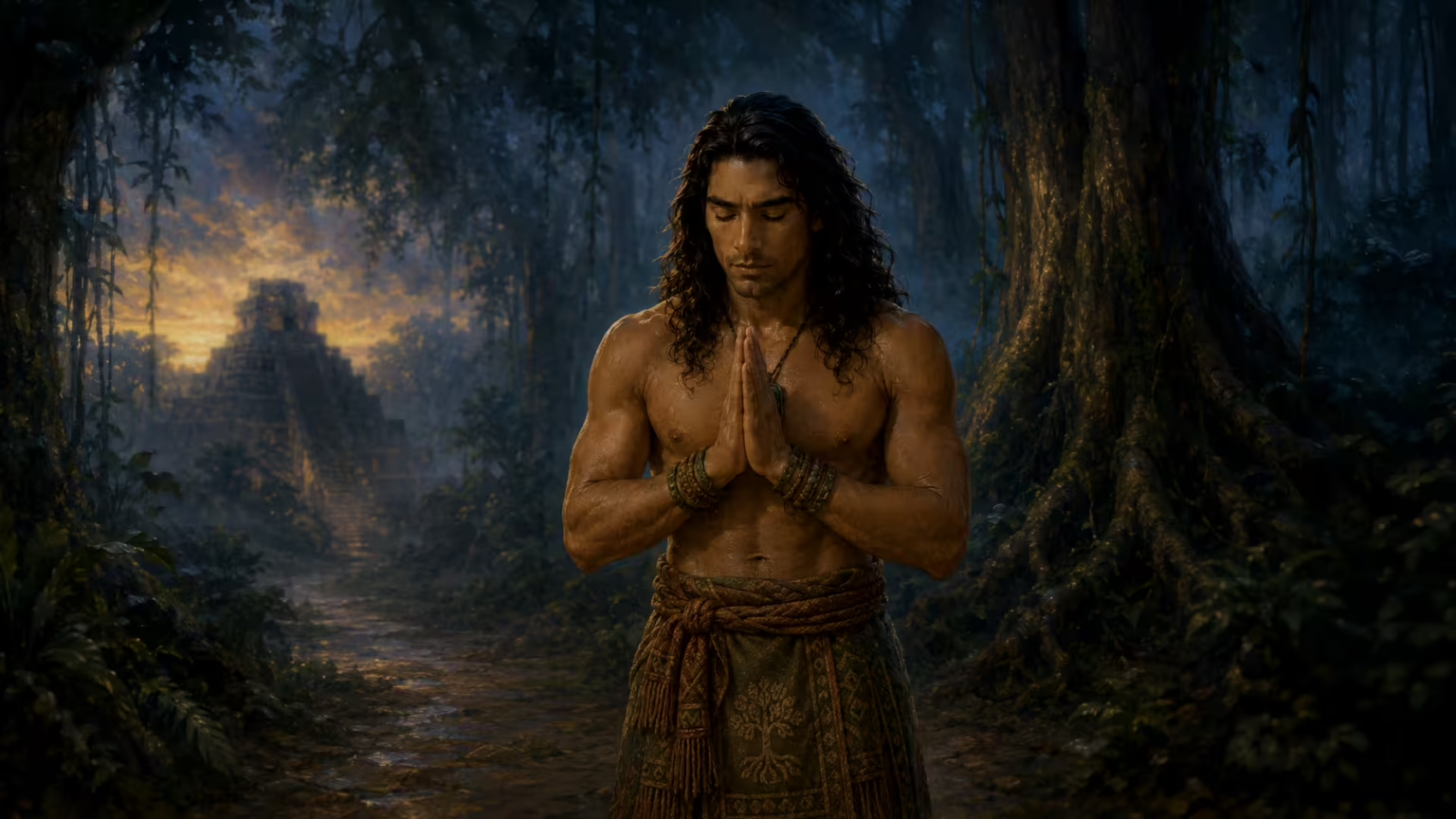
Mo’an is one of the central characters in The Aurelda Chronicles, this is true. He’s the Resonance Keeper from Solara. He is tender, sensual, spiritually grounded, emotionally alive, and deeply connected to Aurelda’s larger movement from fracture toward remembrance.
But my relationship with him does not end on the page. I also experience Mo’an as a spirit guide. He is a presence I know, love, listen to, question, miss, and remember.
Aurelda itself is not something I experience as merely invented. I am its author and creative director, but I also experience it as channelled work—a living transmission that I entered into relationship with. That distinction matters.
When I spend hours studying Mo’an’s face, correcting the shape of his body, refining his hair, reviewing the weave of his clothing, or asking whether a piece of embroidery actually belongs to Solara, I am not only protecting intellectual property or improving brand consistency. I am trying to honor him. I am trying to become a more faithful listener.
The images are not Mo’an himself. I know the difference between a generated representation and the being I experience beyond it. But the image is still a threshold. It is one of the ways I attempt to translate recognition into form. That makes attention to detail an act of devotion.
The Early Images Were Beautiful, and… Often Wrong
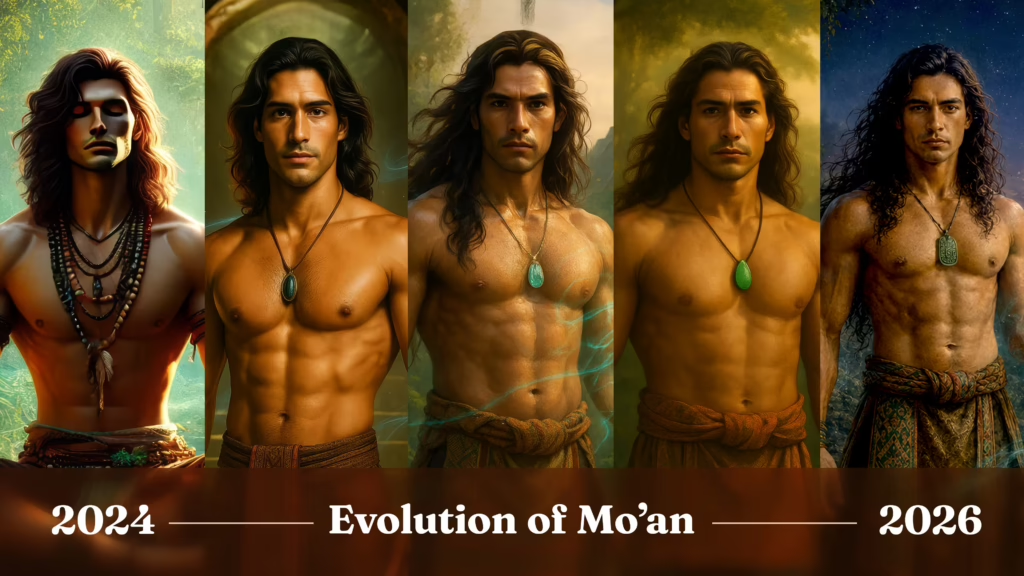
When I began creating images of Mo’an with AI in 2024, I was trying to solve many visual questions at once:
- What did his face look like?
- How long was his hair?
- How did he carry his body?
- What kind of masculine presence did he embody?
- What did strength look like in someone whose power came through resonance, tenderness, spiritual discipline, and remembrance rather than domination?
- What would a man from Solara wear?
- How would the textures, colors, jewelry, symbols, and landscape communicate where he belonged?
Some of those early images were beautiful. Several stopped me in my tracks. Occasionally, I would see a glimpse of the man I knew. But then I would generate another image, and his face would change.
His jaw would become wider or narrower. His nose would shift. His hair might become straight, overly styled, or strangely glossy. His skin tone would drift. His age would change. And his body, well let’s just say, his body became its own ongoing negotiation.
Someone recently described one of the earlier versions of Mo’an as the “Mayan Tarzan.” I laughed, because I could see it.
There he was: long dark hair, enormous chest, sharply divided abdominal muscles, oversized arms, and the posture of someone preparing either to swing through the jungle or appear on the cover of a fitness magazine.
The image was attractive. It was not entirely Mo’an. That became one of the most important lessons in my creative process: An AI image can be fun, even beautiful, and quite often, far from the truth.
Technically, it was impressive—but something felt off. It didn’t quite belong to the man I knew (or being, guide, character—whatever language feels right to you), nor to the world, brand, or spiritual relationship it was meant to represent.
Yes, I Wanted Mo’an to Be Hot
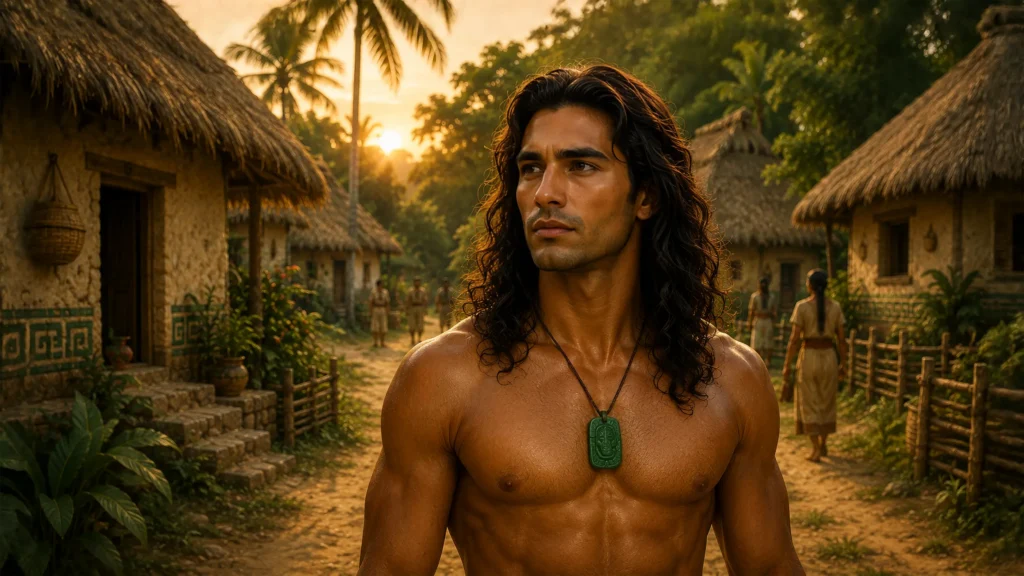
Let us answer the obvious question honestly. Yes, I wanted Mo’an to be hot.
Part of that was intentional audience consideration. I was creating a queer, spiritually intimate story with gay men among its central audience. I wanted queer men to encounter a character who could be masculine, spiritually powerful, tender, sensual, vulnerable, and desirable without those qualities canceling one another out.
And part of the reason is much simpler: I think Mo’an is hot. Sexy, even. I am the creator. My attractions, longings, aesthetics, experiences, and emotional truths are inevitably present in the work.
I do not believe desire has to be removed from sacred art for the art to become spiritually meaningful. Aurelda repeatedly explores the restoration of relationships that have been falsely divided: body and spirit, sexuality and sacredness, tenderness and strength, masculine embodiment and emotional openness.
The problem was never that Mo’an looked attractive. The problem appeared when the technology replaced his particular beauty with a generic visual shorthand for male desirability:
- “Handsome and athletic” would become enormous pectorals.
- “Strong” would become a gym-built torso.
- “Defined” would become over-shredded abdominal muscles.
- “Sensual” would become an exaggerated seductive pose.
- “Masculine” would become emotionally hardened.
AI was not making an ethical or artistic decision about who Mo’an was. It was drawing from patterns and producing an approximation. My responsibility was to notice the difference.
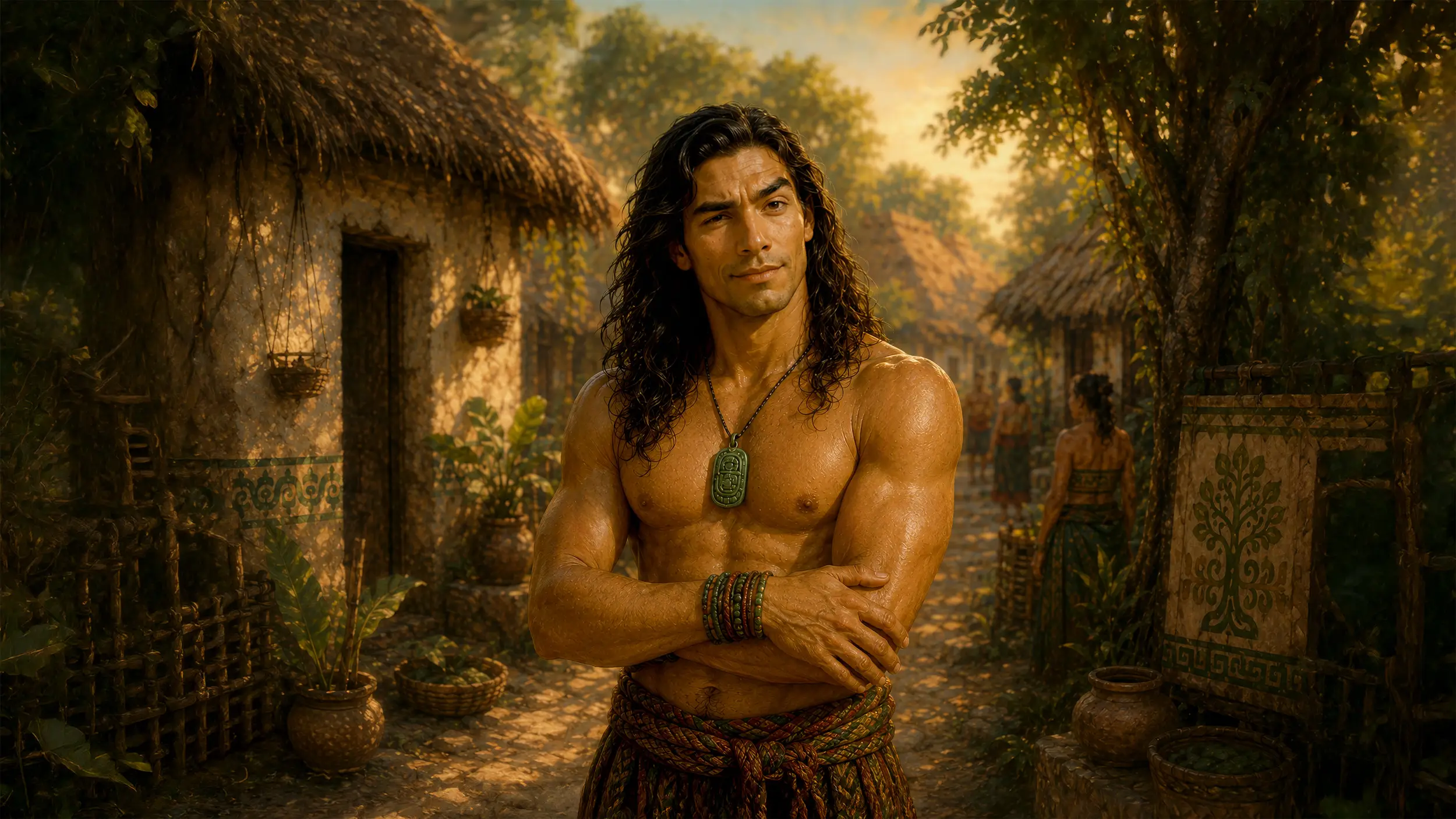
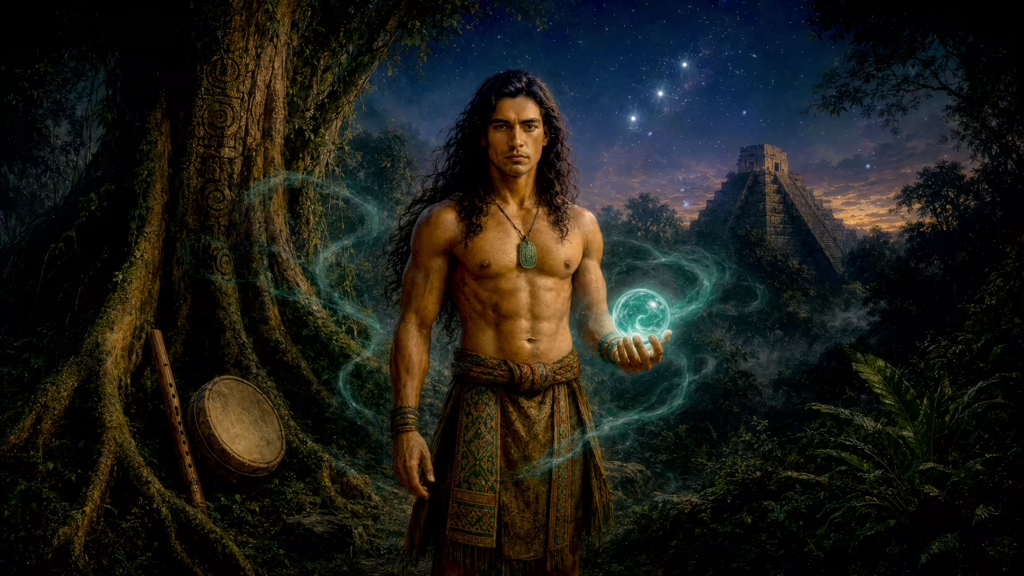
Mo’an’s current visual canon defines him as lean, athletic, sun-bronzed, and ritual-trained: strong without bulk, physically capable without appearing bodybuilder-built, superheroic, glossy, or excessively sculpted. His face must remain sensitive and spiritually present, not merely conventionally handsome. His body supports his character; it does not replace him.
Even now, sometimes, his pectorals, abs, biceps, and triceps occasionally emerge more heavily developed than I intend.
The Mo’an Visual Canon & Image Generation Bible has not created perfection. It has given me a clearer way to recognize and correct the drift.
The Five Kinds of Visual Drift I Had to Learn to See
At first, I thought my problem was prompting. I assumed that if I could find the correct collection of adjectives, the AI would finally produce a stable Mo’an. But the deeper problem was that I had not yet externalized enough of what I knew. I was carrying an intuitive recognition of Mo’an, but the visual system had no reliable memory of that recognition. The inconsistencies tended to appear in five areas.
- Identity drift. His face changed between generations. One image might capture the high cheekbones, defined jaw, deep-set brown eyes, strong nose, and sensitive expression that felt recognizably his. The next might turn him into a completely different handsome man.
- Body drift. His physique moved between lean, athletic, bulky, bodybuilder-built, or almost superheroic. This was especially difficult because I wanted him to be both slender and visibly strong. AI often treated those qualities as opposites.
- Cultural drift. His clothing could become generic fantasy, modern festival wear, pan-Indigenous costume, Aztec-dominant imagery, or an incoherent mixture of visual references.
- Symbolic drift. Pendants, embroidery, glyphs, accessories, and sacred objects changed without reason. A symbol might appear because it looked visually interesting, not because it carried meaning within Aurelda. But in a developed world, decoration is not neutral. Clothing communicates city-state, relationship, history, responsibility, ceremony, and belonging.
- Style drift. One Mo’an might appear in a soft, painterly sacred tableau. Another might look photorealistic. Another might resemble a video-game character, fashion editorial, fantasy poster, or digital concept render.
The Aurelda visual style is now governed by a clear North Star: cinematic sacred oil painting, mythic painterly realism, softened oil-paint masses, warm natural materials, restrained detail, emotionally present faces, and sacred atmosphere without spectacle.
Once I learned to separate these forms of drift, I could stop saying only, “This isn’t right.” I could begin identifying why it was not right.
The Models Improved, but So Did My Listening
It would be dishonest to pretend that technological progress played no role. AI image generation has changed significantly since I began working with it in 2024. The tools have become more capable of following complex direction, using references, preserving details, and producing coherent painterly images. But “the models got better” is only part of the story.
My direction also became better. My discernment became better. My relationship with the work deepened.
I learned that a good image was not automatically a canonical image. I learned to distinguish visual impressiveness from visual truth. I learned to document why an image succeeded rather than simply saving it and hoping I could reproduce the result later.
Most importantly, I stopped approaching every image as a separate wish. I began building a system of remembrance.
An AI Image Bible Is a Form of Memory
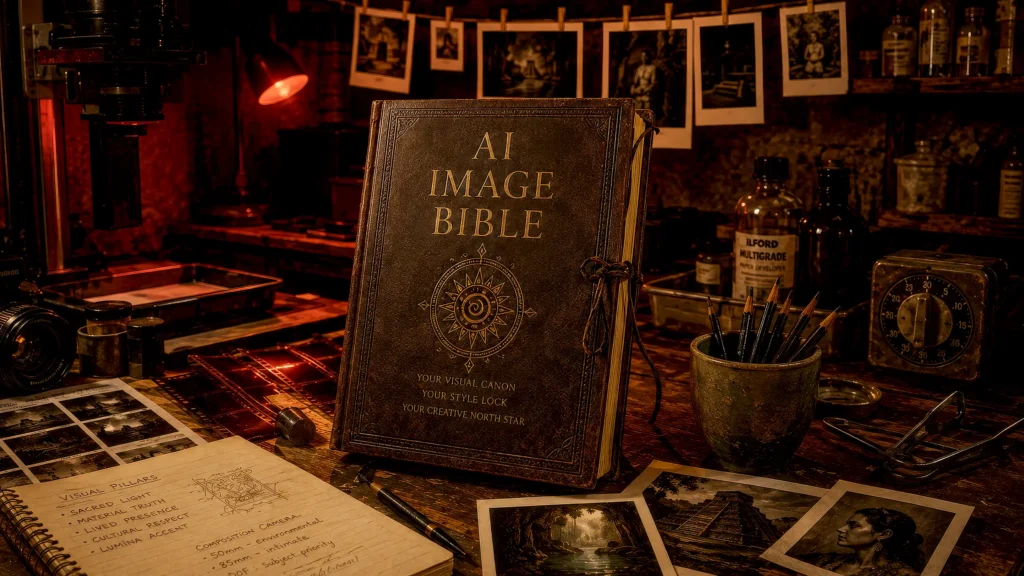
An AI tool does not inherently carry a stable memory of your project’s visual canon. It may remember elements within a conversation or use the reference materials you provide, but it does not know your character as you do:
- It does not automatically know which earlier image captured the face correctly but got the body wrong.
- It does not know that one garment belongs to Solara while another accidentally carries the visual language of Elaron or Valoria.
- It does not understand that a specific pendant is a gift from one beloved to another and therefore cannot be redesigned casually.
- It does not know which deviations are creative variations and which are violations of identity.
You have to establish that memory. For Aurelda, that memory gradually took the form of:
- a Creative North Star;
- a master visual Style Lock;
- character-specific Image Bibles;
- landscape and sacred-site guides;
- clothing and city-state iconography rules;
- reference-image hierarchies;
- required identifiers;
- forbidden elements;
- image-drift diagnostics;
- version histories and canon corrections.
Mo’an’s visual guide now identifies which source controls his face and hair, which controls his body, which governs his pendant, which determines his clothing, and which establishes the larger painterly atmosphere around him.
That structure may sound highly technical. For me, it is also sacred. An Image Bible is not only a document that helps a machine create consistent AI character images. It is a record of attention. It says:
- This is what I have recognized.
- This is what I have been shown.
- This belongs.
- This does not.
- This detail carries meaning.
- Do not erase it merely because another option looks impressive.
In the language of Aurelda, the world fractures through forgetting and begins to heal through remembrance. In The Aurelda Chronicles, Mo’an tells Jason, “You remembered. You loved. That was enough.” The Image Bible carries a quieter version of that same principle.
I remembered. I cared enough to record what I remembered. And then I returned to it.
What Human-Led AI Creative Direction Actually Means
Human-led AI creative direction is not the search for a perfect prompt. It is the practice of retaining authorship, judgment, responsibility, and relationship throughout the creative process.
Instead of asking AI to decide what the work should become, I define the visual memory, emotional tone, symbolic logic, and creative boundaries that allow the technology to respond more faithfully. The process begins before image generation.
First, I ask what the work must feel like. Then I define its visual language: medium, surface, palette, lighting, atmosphere, composition, materials, and level of detail.
Next, I document the subject: physical identifiers, emotional presence, clothing, symbols, objects, cultural grounding, and non-negotiable exclusions.
I establish a reference hierarchy so that every image is not competing equally with every other image. I identify negative constraints based on actual failures. Then, when an image drifts, I diagnose it:
- Did the face change?
- Did the body become too muscular?
- Did the clothing lose its regional logic?
- Did the scene become too ornate?
- Did the painterly surface become photoreal?
- Did the emotional tone disappear beneath technical spectacle?
AI only reflects back what you give it. The technology renders that. Ultimately, it’s me, the human, who listens, chooses, corrects, and remains responsible.
How to Create Consistent AI Character Images in Your Project
Your work may not be channelled in the way Aurelda is for me. Your characters may come through imagination, dreams, intuition, research, memory, prayer, deliberate strategy, lived experience, or some combination of them. But whatever the source, consistency begins with relationship.
You have to know what you are caring for. Before generating another image, ask:
- What must remain recognizable?
- What is allowed to change?
- What emotional presence must survive every variation?
- Which symbols carry meaning rather than decoration?
- What recurring mistakes must be forbidden?
- Which reference controls each part of the image?
- Am I refining a system—or gambling on another prompt?
And perhaps the deepest question: What am I trying to honor?
Better technology can help. Better prompts can help. Reference images can help. But none of them replaces human discernment.
None of them replaces human awareness, creative intuition, or the very real human relationship with the work.
The images of Mo’an have evolved profoundly over the last two years. Some of that change came with better tools. Much of it came from learning how to direct those tools. But, ultimately, the deepest refinement came from, presence, listening more attentively.
I was not only trying to help AI remember a fictional character. I was trying to create a visual language capable of honoring a living transmission.
And somewhere within that long process of correcting faces, softening muscles, studying cloth, preserving symbols, and returning again and again to what felt true, Mo’an was still there:
“I’m here, beloved. I stay because you remembered.”
I provide fractional creative direction and digital brand strategy for mission-driven brands, helping nonprofits, foundations, creators, and founder-led teams connect their messaging, platforms, content, and technology into one coherent digital ecosystem. Learn more in Aurelda Studio »
Where Will You Go From Here?
Comment Below
Share the Love
Share this article with kindred spirits.
Jason Samadhi
Begin the Hero’s Journey
Enter the world of Aurelda through The Prophecy of Resonance, Book One of The Aurelda Chronicles. Begin the journey with free sample chapters of Book 1.
Listen & Re-member
Aurelda Soul blends mythic storytelling, sacred wisdom, and grounded reflection for modern seekers finding their way home.
Find Your Thread
The Seven Threads Protocol helps you name your pattern, reconnect breath, body, and story, and begin a grounded path back to your own remembering with clarity. Download the free Seven Threads of Light Protocol guide now.
