
Reincarnation
This entry may contain affiliate links; your purchases help earn me a small commission at no extra cost, supporting the art and continued growth of Aurelda.
More About 'Reincarnation'
Reincarnation in Aurelda is not punishment, escape, or endless repetition. It is the soul’s return to an unfinished vow. Across lifetimes, a being may forget its name, body, lineage, and beloveds, yet something deeper remains threaded through the Lumina. That thread carries memory without always carrying language. It may appear as longing, recognition, fear, devotion, or the ache of knowing that a life has more roots than the present moment can explain.
In the wider world, people often ask what is reincarnation in spirituality because they are trying to understand whether life carries meaning beyond one body. In Aurelda, the question opens a more intimate gate. Reincarnation is the way memory survives when the mind cannot hold it. It is the way love continues to call across the veil of forgetting. It is the way a fractured soul is given another chance to remember itself with tenderness instead of fear.
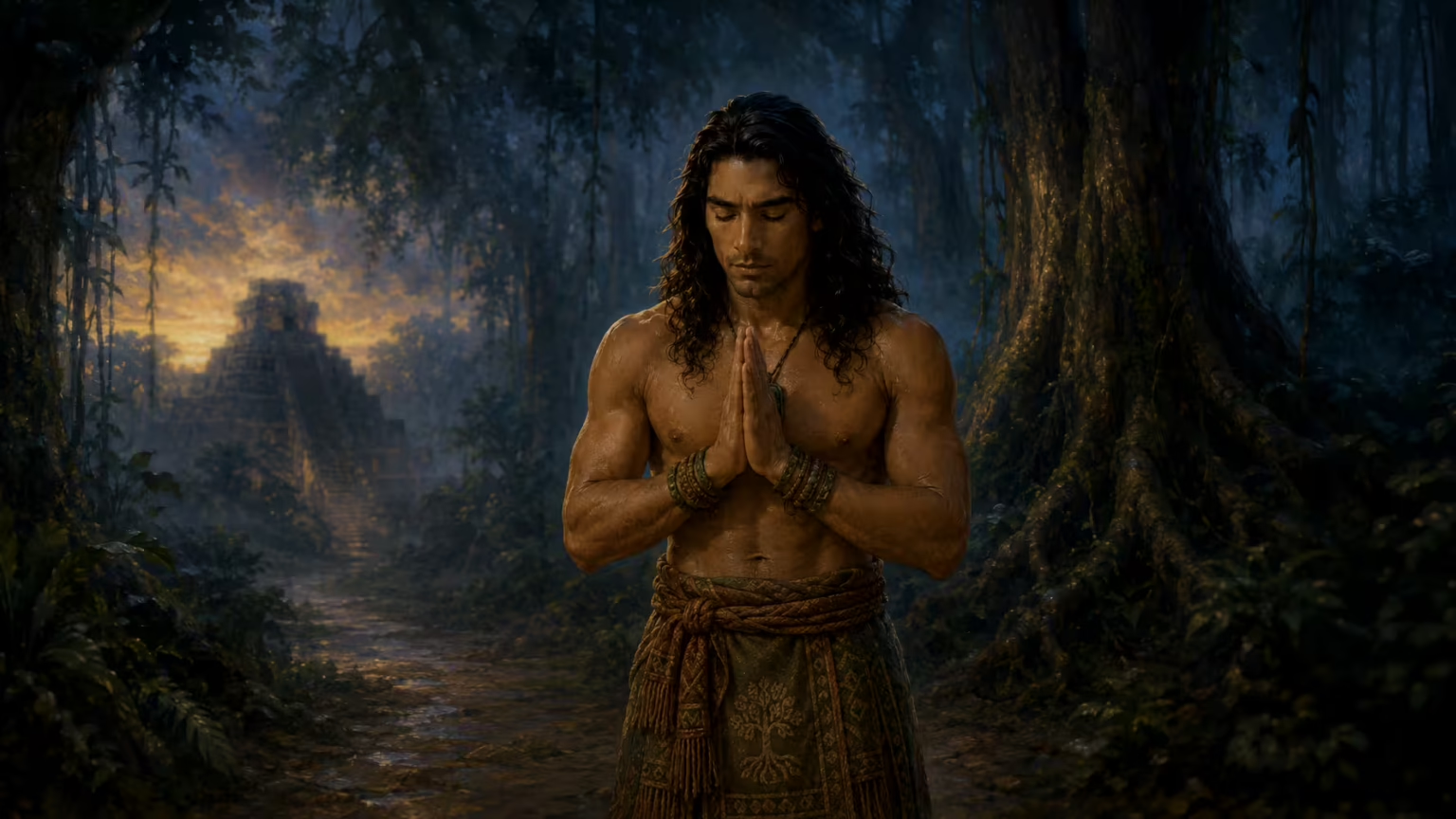
Jason stands at the heart of this teaching. He is not simply a modern seeker who discovers an ancient story. He is bound to Itzam’Yeh, the warrior-scholar whose love for Mo’an reaches beyond death, time, and the visible realm. He also carries the shadow-current of Ma’zheron, the sacred force of longing, chaos, polarity, and unclaimed becoming. These currents do not make Jason less whole. They reveal the work of wholeness asking to be completed through him.
Mo’an is the one who feels this return before it can be fully named. As a Resonance Keeper, he carries ancestral memory not as information alone, but as living resonance. Through him, the Keeper lineage remembers what was lost, what was broken, and what still waits to be healed. Ithanel’s light moves through that lineage as order, balance, and sacred thought. Ma’zheron’s current moves through Jason as shadow, desire, ache, and creative polarity. Their bond is not a romance added to the myth. It is one of the myth’s deepest spiritual architectures.
This is why reincarnation in Aurelda is never only personal. A soul’s forgetting can ripple through the land. A Keeper’s fracture can become K’aal’Zira, the Pulse of Fractured Belief. The earth trembles because the inner world and the outer world are not separate in Aurelda. When the soul rejects part of itself, the Lumina feels the refusal. When the soul begins to remember, the realm begins to breathe again.
Story as Medicine
There is a moment in Jason’s journey when the teaching of reincarnation stops being an idea and becomes a body-level reckoning. He has carried the ache of Itzam’Yeh without fully knowing how to hold it. He has carried the shadow of Ma’zheron without fully believing it can be loved. What rises in him is not only memory, but shame around memory. The old wound whispers that what is fractured must be hidden.
This is where the story becomes medicine. Jason’s struggle mirrors a deeply human pattern: the fear that the part of us shaped by pain, desire, grief, or darkness makes us unworthy of love. Many seekers do not suffer because they have no light. They suffer because they have been taught to divide themselves into acceptable and unacceptable pieces. Aurelda names that division as forgetting.
Mo’an does not meet Jason’s shadow with conquest. He meets it with presence. He becomes a steady field where Jason can begin to feel the difference between being consumed by shadow and allowing shadow to be witnessed. That distinction matters. In Aurelda, healing does not come from banishing Ma’zheron’s current. It comes from remembering that even shadow has a sacred origin when it is returned to love.
This is the story as medicine of reincarnation. A past life does not return simply to prove that time is circular. It returns because something in the soul is ready to be held differently. The memory comes back so the wound can stop repeating itself unconsciously. Jason’s story invites you to ask where your own life may be carrying echoes you have mistaken for flaws. It asks what would happen if the part of you that feels ancient, intense, or difficult is not here to destroy you, but to be welcomed back into wholeness.
Inspiration Notes
Reincarnation is a real-world religious and philosophical concept found in many traditions, though different cultures understand it in different ways. In South Asian traditions such as Hinduism, Jainism, Buddhism, and Sikhism, rebirth is often connected to karma and samsara, the cycle of birth, death, and rebirth. Hindu traditions commonly speak of a transmigrating soul or self, while many Buddhist traditions teach rebirth without a permanent, unchanging self. These differences matter, and Aurelda should not flatten them into one idea.
Ancient Greek thought also preserved teachings of transmigration, often called metempsychosis. Pythagorean, Orphic, Platonic, and Empedoclean traditions each approached the soul’s journey in distinct ways, sometimes linking rebirth with purification, memory, moral order, or the wandering of the soul through different forms of life. Aurelda does not retell these traditions, but it resonates with their shared question: what continues when one life ends?
The Mesoamerican inspiration in Aurelda should be named with care. Classic Maya art and cosmology include powerful patterns of regeneration, divine life cycles, sacred time, and the interconnection of human, natural, and divine realms. The Maize God’s death and renewal, the sacred geometry of cycles, the living relationship between land and spirit, and the power of ancestral presence all inform Aurelda’s atmosphere. This is not the same as claiming Maya religion taught reincarnation in the same way as Indian or Greek traditions. Aurelda is a fictional, Maya-inspired resonance realm that transforms these inspirations into an original mythos of sacred remembering.
Modern academic and clinical research has also studied children who report memories of previous lives. The University of Virginia’s Division of Perceptual Studies has collected thousands of cases, with researchers examining reported statements, behavioral patterns, birthmarks, and possible correspondences with deceased individuals. This research remains controversial and should be handled with care. For Aurelda, its value is not as proof-text, but as a reminder that human beings across cultures continue to ask serious questions about memory, identity, consciousness, and whether the self may be larger than one lifetime.
Reincarnation in Aurelda draws from spiritual traditions of soul return, philosophical teachings on rebirth, cyclical views of time, ancestral memory, and the felt mystery of recognition. It is not presented as historical reconstruction. It is a mythic teaching within a fictional universe, shaped by reverence for ancient wisdom and by the emotional truth of sacred remembering.
At its deepest level, reincarnation in Aurelda is the mercy of another threshold. The soul returns not because it failed, but because love continues to call. The Lumina remembers what the mind forgets. The body carries what the story has not yet spoken. When the soul is ready, memory does not arrive to punish. It arrives to bring the scattered pieces home.
Work Cited
- Aurelda. “Two Become One.” Jason Samadhi. Original date posted: May 15, 2025.
- Aurelda. “The Book of Remembering.” Jason Samadhi. Original date posted: not listed on public page.
- Britannica. “Reincarnation.” Britannica Editors. Original date posted: not listed by publisher. Last updated: March 27, 2026. URL:
- Britannica. “Karma, Samsara, and Moksha.” Edward C. Dimock. Original date posted: not listed by publisher. Last updated: May 4, 2026.
- Stanford Encyclopedia of Philosophy. “Personhood in Classical Indian Philosophy.” Monima Chadha. Original date posted: January 3, 2022.
- Stanford Encyclopedia of Philosophy. “Pythagoras.” Carl Huffman. Original date posted: February 23, 2005. URL:
- Stanford Encyclopedia of Philosophy. “Empedocles.” K. Scarlett Kingsley and Richard Parry. Original date posted: September 26, 2019.
- University of Virginia School of Medicine, Division of Perceptual Studies. “Children Who Report Memories of Past Lives.” University of Virginia School of Medicine. Original date posted: not listed by publisher.
- PubMed. “Children Who Claim Previous Life Memories: A Case Report and Literature Review.” Lucam J. Moraes, Eric V. Ávila-Pires, Mariana S. Nolasco, Thamires S. Rocha, Jim B. Tucker, and Alexander Moreira-Almeida. Original date posted: September 21, 2024.
- The Metropolitan Museum of Art. “Lives of the Gods: Divinity in Maya Art.” The Metropolitan Museum of Art and the Kimbell Art Museum. Original date posted: not listed by publisher.
Where Will You Go From Here?
Comment Below
Share the Love
Share this article with kindred spirits.
Begin the Hero’s Journey of Sacred Remembrance
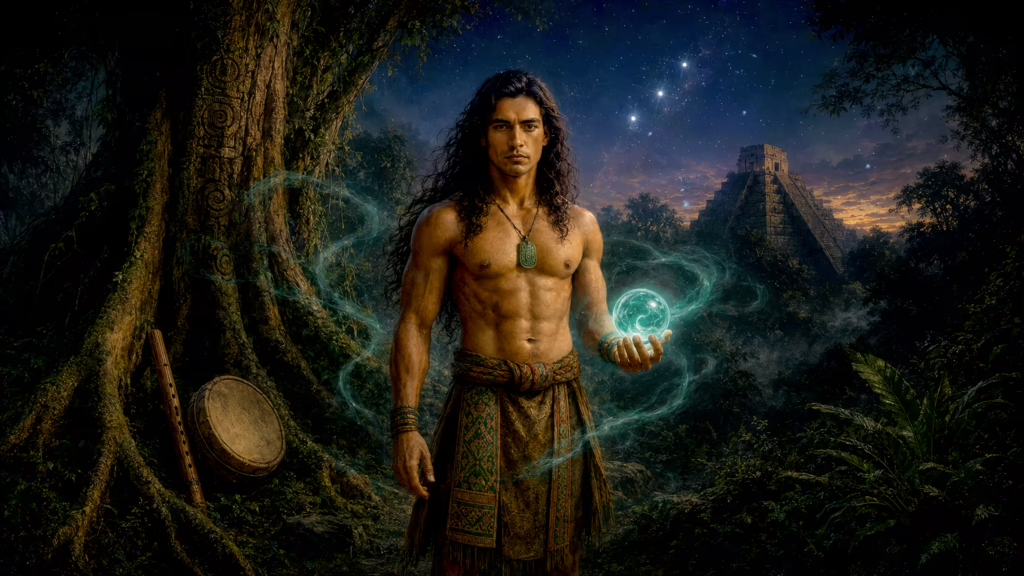
Enter the world of Aurelda through The Prophecy of Resonance, Book One of The Aurelda Chronicles. Journey into Solara, where sacred light, prophecy, found family, and an unlikely Keeper converge as a world begins to lose its way. For a limited time, begin the trilogy with the direct-from-author eBook for $7.99.
Jason Samadhi
Begin the Hero’s Journey
Enter the world of Aurelda through The Prophecy of Resonance, Book One of The Aurelda Chronicles. Begin the journey with free sample chapters of Book 1.
Listen & Re-member
Aurelda Soul blends mythic storytelling, sacred wisdom, and grounded reflection for modern seekers finding their way home.
Find Your Thread
The Seven Threads Protocol helps you name your pattern, reconnect breath, body, and story, and begin a grounded path back to your own remembering with clarity. Download the free Seven Threads of Light Protocol guide now.
