
Gay Spiritual Practices in History: Uncovering Lost Narratives
Gay spiritual practices in history reveals careful, sourced ways queer seekers can approach ancient love, ritual, and sacred belonging.

This post may contain affiliate links; your purchases help earn me a small commission at no extra cost, supporting the art and continued growth of Aurelda.
Across many spiritual traditions, queer people have searched for signs that they were never outside the sacred.
Sometimes those signs appear clearly. Sometimes they arrive as fragments: a ritual role, a carved figure, a tomb image, a myth of divine union, a third-gender lineage, a song, a flower, a body remembered differently by its own people than by colonial observers. The work of reading those fragments requires care. Gay spiritual practices in history cannot be reclaimed by forcing modern labels onto ancient lives, but neither should they be erased because older cultures did not use today’s words.
The wiser path lives between denial and fantasy. It asks what the evidence can support, what it cannot support, and what a queer seeker may still receive as medicine.
Aurelda enters that space as mythic remembrance, not as a claim to reconstruct Earth’s past. It does not say, “This is exactly what happened.” It asks, “What does the soul remember when love, body, breath, and spirit are no longer separated?”
Why Queer Sacred History Needs Care
When people speak about ancient sexuality, two mistakes often appear.
The first is erasure. This happens when all same-sex intimacy, gender variance, or non-binary sacred role is explained away as friendship, symbolism, social custom, or misunderstanding, even when the evidence invites a more complex reading.
The second is overclaiming. This happens when modern terms such as gay, bisexual, transgender, or queer are placed too neatly onto ancient people who lived within entirely different languages, cosmologies, kinship systems, and ritual worlds.
Both mistakes flatten the past. Both can harm the present.
A more honest approach begins with humility. Modern LGBTQ+ identities are real and sacred for those who carry them, but they are not the only way human beings have understood desire, gender, intimacy, or spiritual power. Many cultures have held categories that do not match modern Western labels. Some were honored. Some were tolerated. Some were controlled. Some were later condemned through colonization, missionary violence, empire, or changing religious law.
So the question is not whether ancient people were “just like us.” The better question is this: where do the records show that gender, desire, ritual, beauty, and sacred role were more fluid than many modern teachings admit?
Xochipilli and the Sacred Language of Beauty
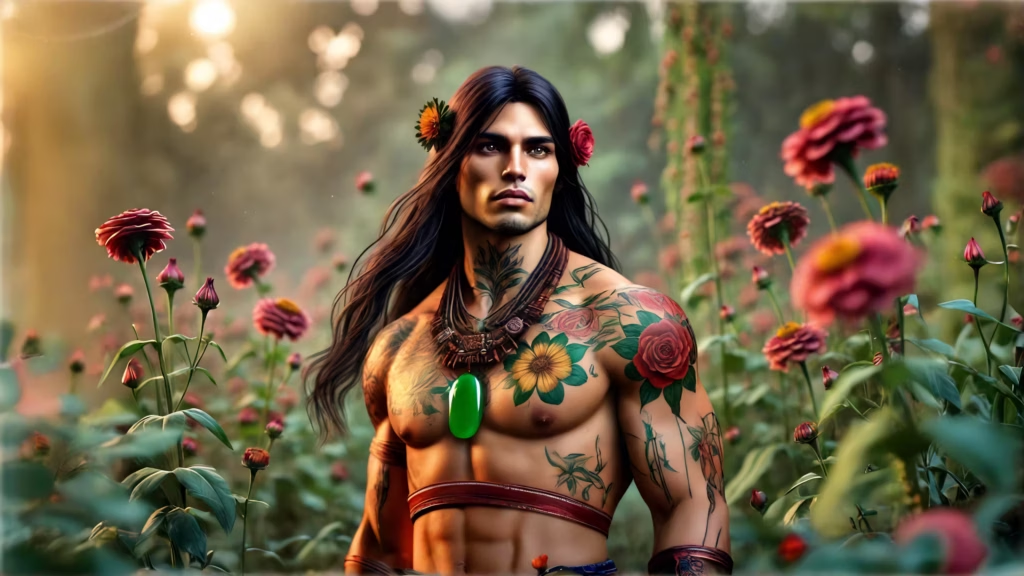
In Mexica tradition, Xochipilli is associated with flowers, fertility, nobility, poetry, and song. Some educational and archaeological sources also discuss his connection with sacred plants and ritual communication with divinity.
That does not make Xochipilli a “gay god” in the modern sense. The evidence does not require that claim. What it does offer is subtler and perhaps more powerful: a divine figure in whom beauty, pleasure, song, flowers, sacred plant symbolism, fertility, and ritual life gather in one radiant form.
For queer seekers, Xochipilli can become a symbolic doorway into a wider truth. Pleasure has not always been treated as spiritually empty. Beauty has not always been treated as frivolous. The body, ornamented and alive, has not always been cast outside the sacred.
Aurelda draws from this kind of resonance with caution. It does not copy Xochipilli into its world. It lets the echo teach reverence: that sacredness may arrive through fragrance, color, song, sensual presence, and the living intelligence of the body.
Muxes and the Living Complexity of Gender
Among Zapotec communities in the Isthmus of Tehuantepec, muxes are often described as a third-gender identity. Educational sources from Mexico describe muxes as people assigned male at birth who may adopt feminine roles, social responsibilities, styles of dress, or forms of gendered life that do not fit the dominant male identity.
This is not the same as saying muxes are simply “gay men” or “trans women” in Western terms. Some may relate to those terms. Some may not. Their meaning is rooted in Zapotec culture, family structures, community roles, language, and place.
That distinction matters. Queer spiritual history becomes more respectful when it does not absorb Indigenous identities into a global LGBTQ+ label without permission. Muxe life is not a metaphor for someone else’s awakening. It is a living cultural reality.
Still, muxes remind modern seekers that strict gender binaries are not universal law. They are historical arrangements. They can be enforced, softened, resisted, or reimagined. For someone who has been told that only one kind of masculinity can be holy, this matters deeply.
Two-Spirit Roles and the Warning Against Simplification
The term Two-Spirit is used by some Indigenous peoples in North America, but it does not simply mean someone who is Native and gay. Government health education sources and Indigenous scholarship emphasize that Two-Spirit identities vary across nations, languages, and traditions. In many communities, gender-variant people held distinct social, artistic, healing, ceremonial, or spiritual roles. In others, the meanings were different.
This is where care becomes sacred practice.
A non-Indigenous reader should not claim Two-Spirit identity as a personal label unless it belongs to their people and community. The teaching is not appropriation. The teaching is reverence. It is the recognition that colonization did not merely attack land. It also attacked bodies, kinship, gender, ceremony, and the sacred languages through which people understood themselves.
For queer seekers outside those traditions, the lesson is not “this identity is mine.” The lesson is, “the modern binary is not the only way human beings have known spirit.”
Ancient Egypt and the Limits of the Image
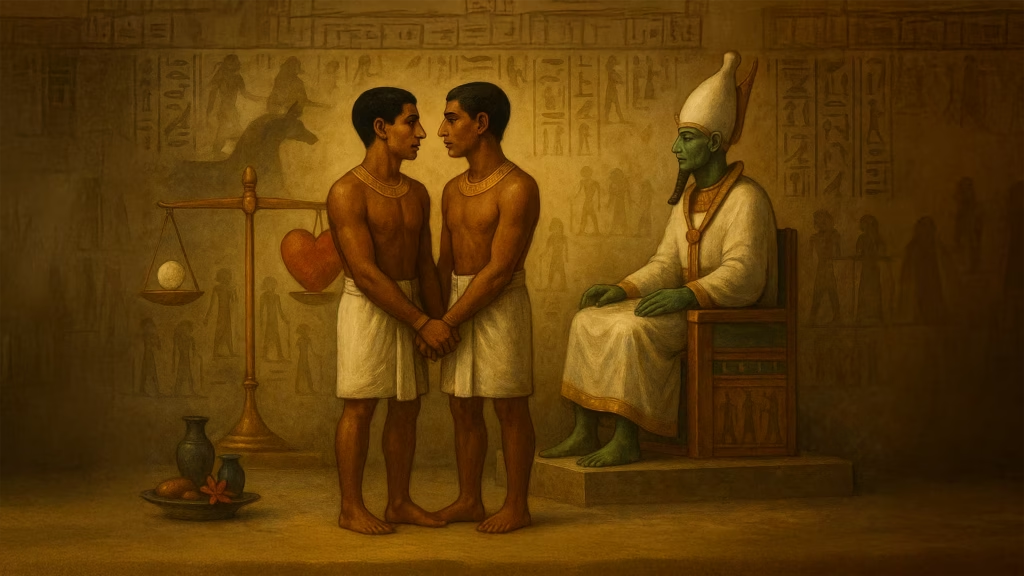
The tomb of Niankhkhnum and Khnumhotep, two Fifth Dynasty officials in Egypt, is often named in LGBTQ+ history because its imagery shows the two men holding hands and embracing in ways that have invited comparison to conjugal art.
The scholarship is debated. Some scholars have argued that the iconography allows a same-sex couple reading. Others argue that the evidence better supports a twin or sibling interpretation. Egyptologists also caution that embraces, kisses, and paired images can carry many meanings in ancient funerary art.
This is exactly why queer sacred history requires both courage and restraint.
It is courageous to notice when evidence has been filtered through assumptions that heterosexuality is always the default. It is restrained to admit when the record cannot prove what the heart may want to see.
The medicine here is not certainty. The medicine is a better way of looking. Queer history does not need every ancient image to become proof. Sometimes it is enough to let an image trouble the certainty of erasure.
Greek Eros and the Ascent of Desire
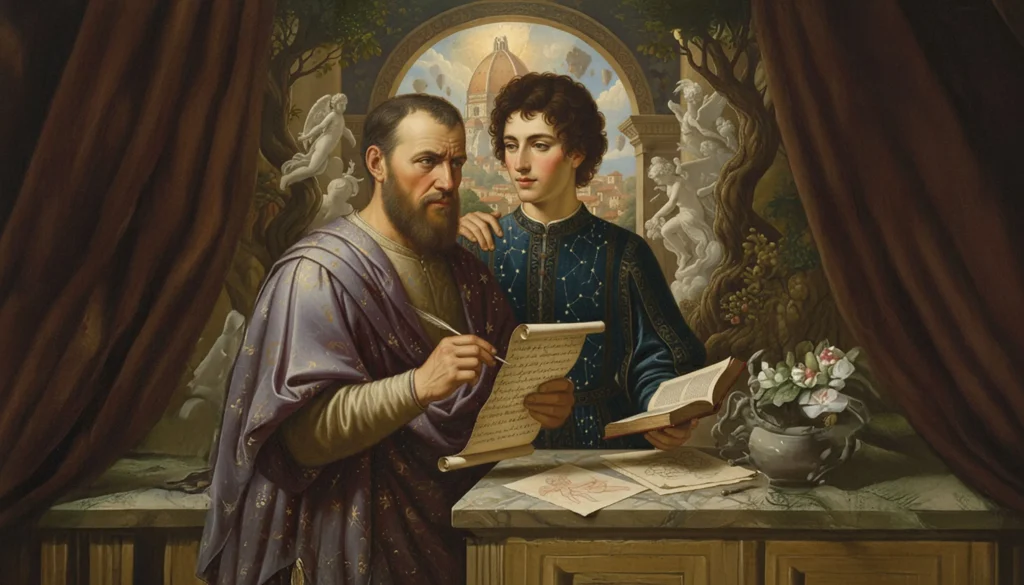
In ancient Greek literature, same-sex eroticism appears in philosophical, educational, social, and literary contexts. Plato’s Symposium and Phaedrus became especially influential because they explore eros as a force that can begin in attraction and lead toward beauty, goodness, and philosophical ascent.
This does not make ancient Greece a modern queer utopia. Many Greek practices involved age, class, gender, and power dynamics that require honest ethical distance today. A careful reader should not romanticize every ancient form of same-sex desire.
Yet the presence of male-male eros inside philosophical conversations about beauty and the soul remains significant. It shows that desire between men was not always treated only as sin, pathology, or social ruin. In some texts, eros became a doorway into contemplation.
For a modern gay or queer reader, this can be healing when held with discernment. Desire does not have to be reduced to impulse. Desire can become a question that leads inward: What am I seeking through beauty? What does longing reveal? What kind of love makes the soul more truthful?
What “Gay Spiritual Practices” Can Mean Today
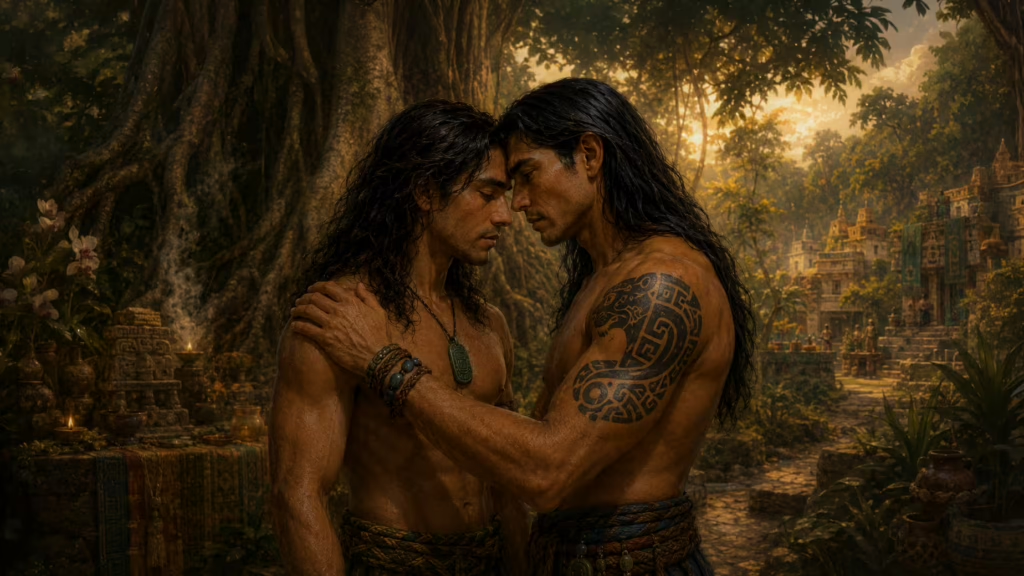
Because ancient categories do not map neatly onto modern identities, gay spiritual practices in history should not be treated as a single uninterrupted tradition. There is no one universal ancient gay ritual waiting to be recovered.
What can be recovered is a set of human patterns:
- Queer and gender-diverse people have often lived near thresholds.
- Bodies outside the norm have often been feared, controlled, honored, eroticized, or ritualized.
- Same-sex love and gender variance have appeared in myth, art, ceremony, poetry, and social roles across cultures.
- Colonial and religious systems have often rewritten, punished, or obscured these realities.
Modern queer seekers can approach the past without stealing from it, flattening it, or demanding that it confirm every present need. This is where practice begins. A gay spiritual practice today might be breath before desire, so the body can tell the truth.
- It might be ancestral study done slowly, with sources open and ego quiet.
- It might be lighting a candle for the unknown queer dead whose names were never written down.
- It might be refusing to make shame the priest of your inner temple.
- It might be reading myth not as proof, but as medicine.
Story as Medicine: A Non-Spoiler Glimpse from Aurelda
In Aurelda, same-sex love and fluid identity are not decorations placed on the edge of the story. They are woven into the cosmology of the realm. Mo’an, a Resonance Keeper and spiritual warrior, carries a kind of sacred fluidity that reflects the Lumina itself: moving, listening, joining, remembering.
This is not offered as historical evidence. It is offered as story as medicine.
A reader does not need plot revelations to receive the mirror. Mo’an’s path offers a sacred question: what if tenderness is not a weakness to be corrected, but a form of spiritual perception? What if love between men can be more than desire, more than rebellion, more than survival? What if it can become a threshold where the fractured self begins to remember its wholeness?
That is the medicine of Aurelda. It does not ask ancient history to prove that queer love is sacred. It lets the story embody a truth the reader may already know in the body: love that restores presence is holy.
Reclaiming Without Taking
A respectful queer spirituality does not need to own every ancient symbol. It can listen.
- It can listen to Xochipilli without turning him into a modern identity poster.
- It can honor muxes without translating them into a Western category.
- It can respect Two-Spirit traditions without claiming them.
- It can study Egyptian imagery without pretending the debate is settled.
- It can read Greek eros without ignoring ethical complexity.
This kind of practice is quieter than certainty, but it is stronger. It allows queer seekers to belong to the sacred without distorting the sacred lives of others.
The past is not a cupboard of symbols to raid. It is an archive of human longing. Some pages are clear. Some are damaged. Some are missing. Some were burned. Some survived as song.
Aurelda stands beside that archive as a mythic companion. Not history. Not doctrine. A living mirror. A place where queer love, sacred sexuality, breath, story, and remembrance can move together without apology.
And perhaps that is the deeper reclamation. Not proving that every ancestor would have named you exactly as you name yourself now, but realizing that the sacred has always been wider than the cages built around it.
If the hidden histories of queer sacred belonging are beginning to stir your own remembrance, will you follow the thread into the Aurelda Codex?
Works Cited
- Aguilera, Carmen. “Xochipilli, Dios Solar.” Estudios de Cultura Náhuatl, Universidad Nacional Autónoma de México. Original publication date: 2009.
- Evans, Linda, and Alexandra Woods. “Further Evidence that Niankhkhnum and Khnumhotep Were Twins.” Journal of Egyptian Archaeology. Original publication date: 2016.
- Hubbard, Thomas K. “Historical Views of Homosexuality: Ancient Greece.” Oxford Research Encyclopedia of Politics, Oxford University Press. Original date posted: May 29, 2020.
- Indian Health Service. “Two-Spirit.” Indian Health Service, U.S. Department of Health and Human Services. Original date posted: not listed on page.
- Instituto Nacional de Antropología e Historia. “Xochipilli, señor de las flores.” INAH Foto del Día. Original date posted: June 12, 2024.
- Parkinson, R. B. “The First Gay Kiss? An Ancient Egyptian Embrace Between Two Men.” University of Oxford Research Archive. Original publication date: 2019.
- Santillán, María Luisa. “Los Muxes, el Tercer Género.” Ciencia UNAM, Dirección General de Divulgación de la Ciencia. Original date posted: November 4, 2019.
- Traub, Valerie. “Plato and the Philosophical Dialogue.” The Cambridge History of Gay and Lesbian Literature, Cambridge University Press. Original publication date: 2014.
Where Will You Go From Here?
Comment Below
Share the Love
Share this article with kindred spirits.
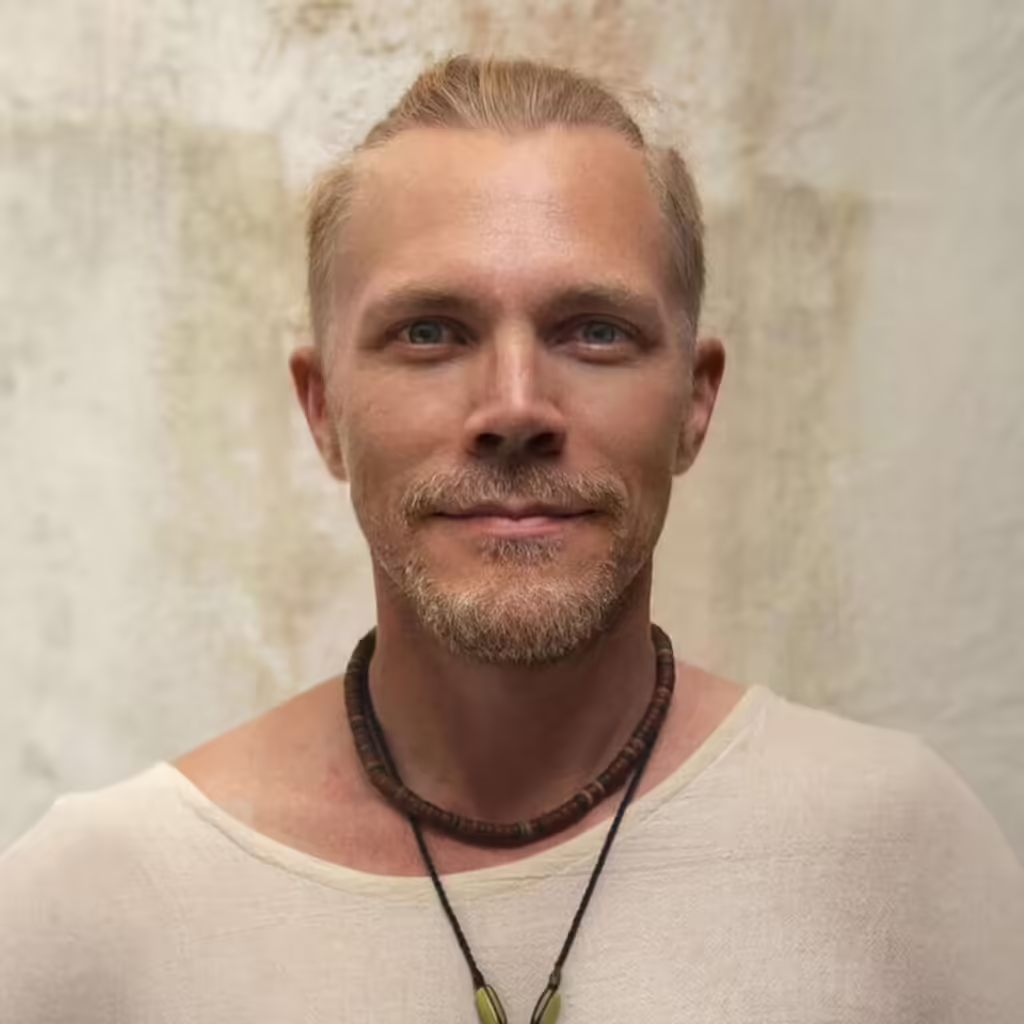
Jason Samadhi
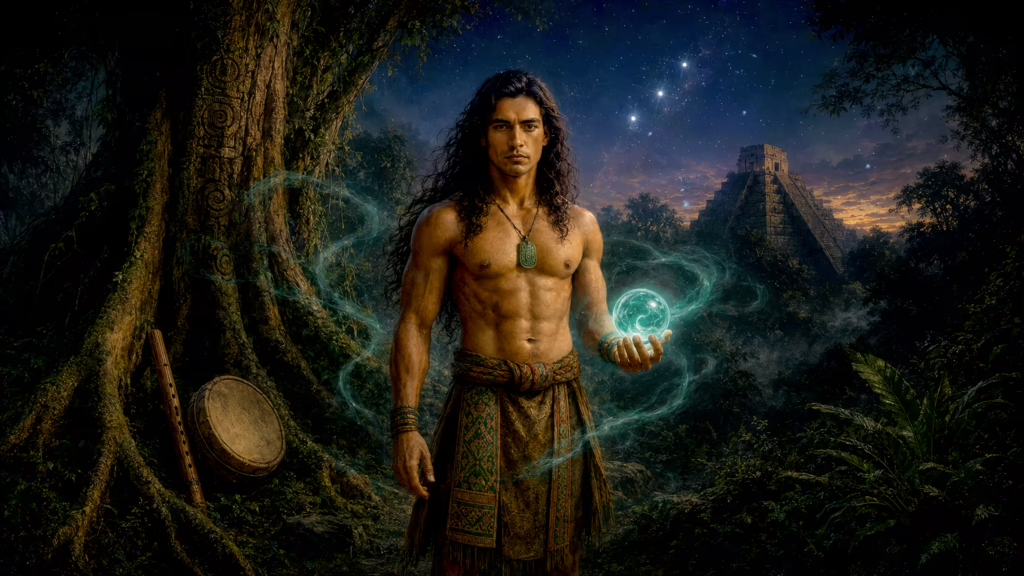
Begin the Hero’s Journey
Enter the world of Aurelda through The Prophecy of Resonance, Book One of The Aurelda Chronicles. Begin the journey with free sample chapters of Book 1.
Listen & Re-member
Aurelda Soul blends mythic storytelling, sacred wisdom, and grounded reflection for modern seekers finding their way home.
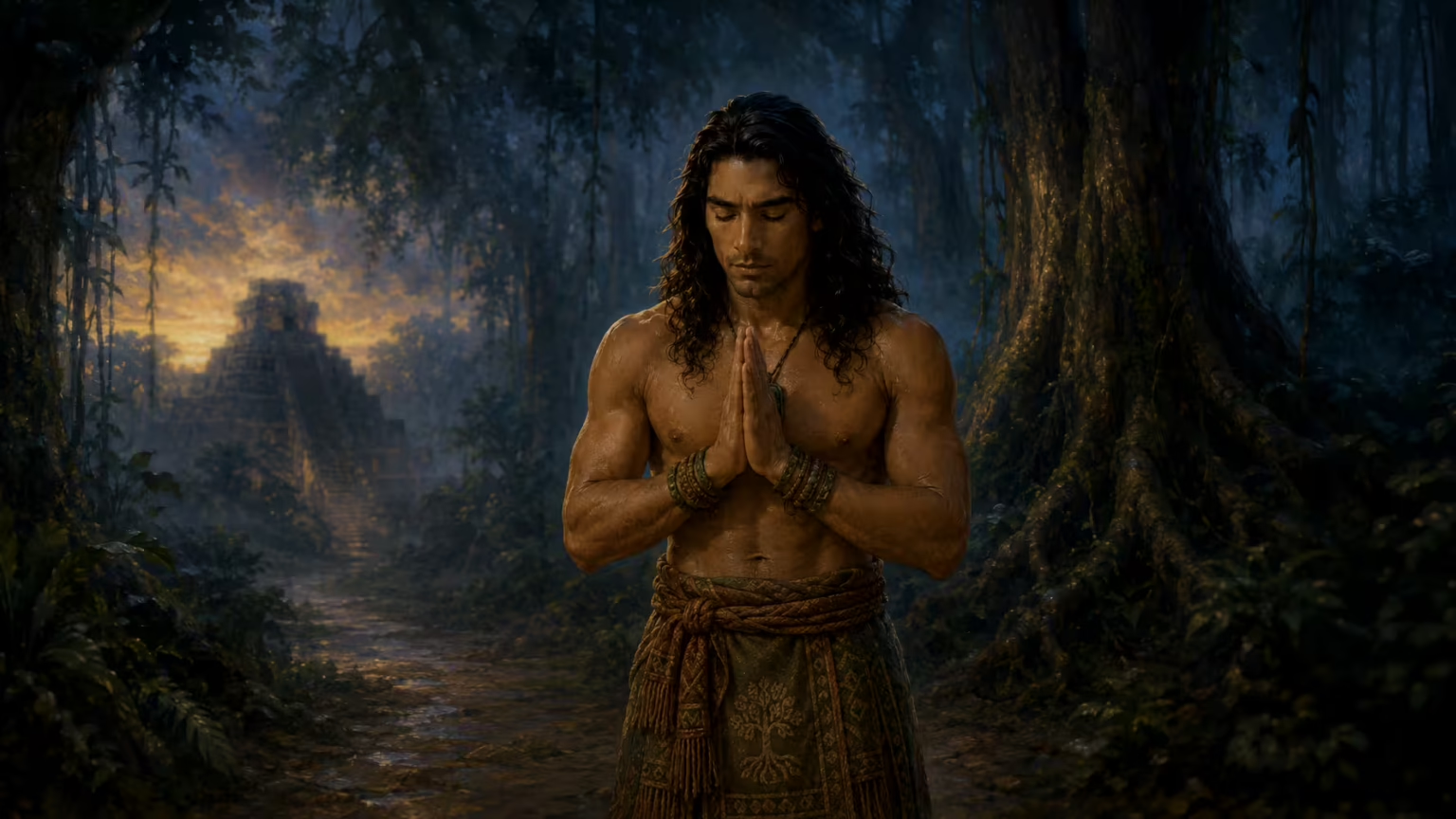
Find Your Thread
The Seven Threads Protocol helps you name your pattern, reconnect breath, body, and story, and begin a grounded path back to your own remembering with clarity. Download the free Seven Threads of Light Protocol guide now.
