
Climate, AI and Authoritarianism: Humanity at the Crossroads
AI and authoritarianism are reshaping truth, democracy, and climate action. A frank Aurelda inquiry with sources, breath, and practical agency.
This post may contain affiliate links; your purchases help earn me a small commission at no extra cost, supporting the art and continued growth of Aurelda.
I’ve been wrestling with the question: Are we still at a choice point, or have we blown right past it? In an era of rising authoritarianism, blinding AI advances, and a climate on the brink, it’s easy to swing between despair and delusion. But I want to be honest with myself (and with you): the truth is a both/and, not an either/or. Some thresholds have been crossed (for example, our planet has already locked in serious warming), but other choices are still open. We’re late, but not finished.
I see parallels everywhere: systems of power reshape our collective story to stay in control, just as I reshape breath into mythic story in Aurelda. If those in power can redefine history, perception, and science, they steal our agency. No wonder “awakening” often feels like digging through old ruins instead of soaring. We descend to retrieve truth so we can ultimately ascend with clarity. The real question becomes: when do we say “enough” and change course? According to experts, that moment isn’t here yet – but it isn’t beyond reach either.
Climate, AI and Authoritarianism: Why Truth and Memory Matter
Power controls narrative. Why has history often been rewritten or erased? Because whoever controls memory controls possibility. Dominant cultures—from empires to families—have “edited” uncomfortable truths for millennia. When a society’s identity rests on past violence or exploitation, admitting that truth threatens the entire structure. So lies get enshrined in textbooks, monuments, even national myths.
For example, in Canada the dark history of residential schools was long hidden. One Truth and Reconciliation report notes that “for generations, the truth…about residential schools was not taught to most Canadians”, leading many to downplay the trauma inflicted on Indigenous children. It took years of survivors speaking out and formal truth commissions to rewrite that narrative in the public consciousness. This is resilience in action: “Museums are not only stewards of memory—they are also powerful platforms for building resilience in the face of historical trauma”. When communities preserve difficult histories, they heal and gain strength for the future.
In short, memory is powerful. Memory can be a shield or a weapon. When we lose memory, we lose context for what to fight for. And when we recover suppressed memory, we connect our wounds into wisdom. It hurts, but it also frees us. Consciousness can’t fully rise until it digs out the roots of lies. This is why so many spiritual paths emphasize underworld journeys, tombs, or silence. The darkness is part of the journey, not a trap.
The Global Turn Toward Authoritarianism
If rewriting history is an old trick, today’s shift feels especially sharp. Democracy indices and human-rights groups are flashing red. The Varieties of Democracy (V-Dem) Institute reports that global democracy has been in decline for decades, with no sign of slowing.
Today’s world is approximately as undemocratic as it was in the early 1980s. Even big democracies aren’t safe; out of the world’s five most populous nations (China, India, Indonesia, Pakistan, USA), only the U.S. still counts as a democracy – and that too is “in jeopardy” under current trends.
Human Rights Watch found much the same story about the U.S.: in 2025 they documented “a decided shift toward authoritarianism” in the first year of a second term. They cited abuses in immigration policy, voting rights, and attacks on the judiciary and press. In short, the “rules-based order” that democracies rely on was being dismantled. And this isn’t unique to one leader or party, it’s part of a global wave. Larger powers like China or re-empowered authoritarian states lend quiet assent, shifting norms even in other countries.
All this is terrifying, but not irreversible. History is full of cycles: democracy wanes and waxes. The V-Dem report explicitly notes that declines “have affected many large and populous countries”, which means the stakes are high—but it also means the action is on a scale where change is possible. After all, Canada or Cambodia turned corners through collective effort.
The real danger is when we internalize the narrative of “doom = destiny.” What’s true is that we’re in a tight race. Authoritarian systems seek compliant bodies and opinions that echo their story. But those very measures, media control, propaganda, and surveillance, sow distrust. They make each generation doubt the narrative or crave authenticity. A living myth like Aurelda can stand at that fault line, reminding people to verify what they are told and to trust their bodies and breath.
AI: Instrument, Oracle, or Mirror?
Artificial intelligence adds a new dimension. On one hand, mass data and algorithms give authoritarian regimes unprecedented surveillance and propaganda tools. On the other hand, AI tools can democratize insight and detect patterns (climate anomalies, epidemiological threats, even election irregularities) if governed well. The important nuance: AI isn’t inherently benevolent or malevolent; its impact depends on our choices and values.
This is why global organizations stress human-centered AI now. For example, UNESCO’s 2021 Recommendation on AI Ethics, adopted by all member states, puts “the protection of human rights and dignity” at its center. The key principle is that people must stay in the loop, not be reduced to data points.
Similarly, the OECD’s recent report Governing with AI underscores that governments should build “enablers” like data infrastructure and invest in oversight, essentially building guardrails rather than jumping in blind. In short: we are still in a live debate. Laws and norms are being written now, and every regulation or standard is a choice that will lock in future AI behaviors.
The window is narrowing, but it’s open. Look at how tech giants raced to build generative AI and only later did governments scramble to regulate it. The same pattern plays out in digital authoritarianism: governments create big data monopolies (think of China’s Social Credit or surveillance cameras), and then companies build products that fit those needs.
But activists and policymakers are pushing back. A recent Harvard ethics initiative argues we must include citizens and activists in AI governance discussions, to demand transparency and accountability.
From the Aurelda perspective, the lesson is clear: don’t outsource wisdom to the machine. Use AI as a mirror or a tool that amplifies your own insights, not as an oracle delivering unquestioned truth. If a story or mythic symbol appears, check it by feeling it in your body. Use breath and presence to test what feels real.
That’s how conscious myth diverges from propaganda: a mythic narrative like Aurelda is strongest when it points you toward your own truth and responsibility, not when it spoon-feeds answers. In a time of rapid AI entanglement, training discernment is as important as technical literacy.
Climate Change: Thresholds and Agency

The climate crisis is the great test of our era. The research is sobering: human-made warming has already locked in severe impacts, and 2024 was likely the first year with a global average above 1.5°C of warming. We are living the consequences: more wildfires, heatwaves, droughts, floods.
Yet the science is equally clear that how far we fall into crisis is still a choice. Every fraction of a degree matters. The CARE climate coalition notes that “with every fraction of a degree, it becomes harder for vulnerable communities to escape the cycle of poverty and inequality”. In practice, that means policy choices still matter massively.
Fortunately, climate scientists stress that it isn’t too late to avoid the worst. NASA’s climate FAQ bluntly says: “Without major action… global temperature is on track to rise by 2.5–4.5°C by 2100… But it may not be too late to avoid or limit some of the worst effects of climate change.”.
In other words, we’ve committed to serious harm already (we have passed some “tipping points” like massive glacial melt). But the future warming is still ours to influence. Their advice: Mitigate emissions hard and adapt to changes. Keep digging up solar, wind, conservation – because any cut in emissions still buys time and saves lives.
The 2018 IPCC Special Report on 1.5°C is also hopeful in context. It found that while the 1.5°C limit is extremely challenging, it’s still achievable if nations act immediately and decisively. CARE quotes a climate lead: “It has not become more difficult to keep global warming below 1.5°C. We do still have time to mitigate the worst impacts, but governments must act immediately”.
And remember, even if 1.5°C is surpassed, the IPCC emphasizes that every tenth of a degree matters – the difference between 1.6 and 2.0 could mean huge differences in crop yields, storm intensity, and human suffering.
So are the climate die rolled? Partly, but not entirely. Our children will live with floods and heat storms for centuries, because of inertia. But catastrophic scenarios aren’t a script set in stone yet. The fastest emissions cuts and technological fixes (like carbon capture) are still at our disposal.
This crisis is forcing many to stop fantasizing about business-as-usual and to reckon with “collective grief” – not as paralyzing despair, but as fertilizer for change. The Earth doesn’t give us a “reboot” option, but it does show us which pathways remain open and where the thorns are. We still know which branches to climb.
Descent to Ascend: The Nature of Awakening
So yes, some road forks have been missed and some bridges burned. It’s time we admit that publicly: saying “we have passed some point of no return” is not defeatism; it’s clarity. At the same time, we must avoid sliding into defeatism that convinces everyone to give up. The truth is gritty: we are late, but we’re not done. There is no magical Second Coming that will instantly fix history’s trauma or reboot the climate. These are processes.
Spiritual traditions hint at this tension. Many speak of a necessary descent—into the underworld, the dark night of the soul, or the tomb—so that the self can be “born again” into truth. The rabbit hole of conspiracies or “hidden truth” hunts can be a kind of shadow side of this.
That’s why I said earlier: discerning awakening from obsession is crucial. You can get stuck in the ruins of power, endlessly excavating conspiracies, and never emerge. Authentic awakening is when seeing reality, however grim, leads you out into action, compassion, and solidarity, not into more fear.
In other words, there is no requirement to live in despair, only an invitation to wake up enough to handle the darkness without panicking. It reminds me: a myth must not become a comfort blanket. Aurelda’s myths, our myths, need to be if anything tougher than iron. To face the big questions, not numb them. If we only wanted comfort, we’d retreat into fantasy. Instead, Aurelda’s narratives are supposed to reflect the challenges of this world back at us, asking: “How do you respond now?”
In practical terms: enough digging is when your revelations stop being an escape and start transforming your life. You stop just ranting on forums about false flags, and you start coaching neighbors on emergencies, planting real gardens, re-sharing climate science, or electing responsive leaders. Enough is when the “truth-seeker” becomes the citizen-builder. And that’s why I believe the collective “enough” can come incrementally. One person, one community at a time.
The Role of Aurelda: Myth, Breath, and Resistance

Where does all this leave a queer mythic storyteller and breathwork guide like me? Right in the middle of the fray. I’ve always believed Aurelda is not escapism. It’s meant to be counter-infrastructure for the soul in hard times. Authoritarianism and runaway AI want us weak in body and memory; my work tries to do the opposite: strengthen body and memory through story and breath.
Breathwork is not just poetic; it has science behind it. Modern research shows that slow, intentional breathing can shift our nervous system out of fight-or-flight and into regulation. This literally builds resilience, the capacity to stay present instead of freezing or panicking. When an entire society learns to breathe into fear, it becomes much harder to herd us with propaganda or shock us into obedience.
Aurelda’s practice blends these breath techniques (drawing on SOMA Breath® methods) with cultural imagery from the Riviera Maya, because cultures that honor ritual memory tend to have psychological fortitude.
Mythic storytelling is another vector. Living mythology (like Aurelda’s narratives) is training for the imagination of resistance. It reminds us that we’re part of a larger story of emergence. Historically, humans have invoked myth to find coherence amid chaos. Even those raised in rationalist cultures unconsciously follow inherited narratives (national, religious, or ideological). Aurelda asks people to become conscious “authors” of the next chapter of humanity. It’s not “true” in a historical sense; it’s true in the sense that it gives shape and meaning to our real-world struggles.
In practical civic terms, Aurelda aims to make people harder to manipulate. Every time I guide someone through a ceremony or a breath sequence, I’m hoping they learn to source strength internally rather than from external validation. It’s one thing to know a conspiracy is false; it’s another to feel, in your bones, that you don’t need it to feel safe. When enough people realize they don’t have to fear or obsess in order to care and act, authoritarianism loses one of its main levers: fear-based obedience.
So does Aurelda “fix” Trump or climate change? Of course not by itself. But it can help train the people who do the fixing. These ideas aren’t just whimsical; consider this: in each era where people have truly “woken up,” it’s often been through culture. The spiritual, queer, and artist communities often feel these shifts first, and they’ll be the canaries in the coal mine of collapse or renewal. A framework that keeps those communities centered and whole, instead of radicalized or burned out, is both spiritual ministry and civic necessity.
Possible and Practical Awakening
Let me circle back to where we started: Are we past the point of no return? The sober answer is: we have crossed some points of no return (in climate and in some institutions). But it is absolutely not the case that our story is over. Historians and researchers agree: democratic backsliding has been serious, but not irreversible. Climate-wise, some damage is inevitable, but the worst scenarios are avoidable if we act with urgency. AI governance? We’re in the active shaping phase – not after the fact.
So yes, our choices have narrowed, but they haven’t vanished. That “crossroads” metaphor is more like a complex interchange: some lanes are closed off, new ones have opened, and it’s dark out there. The question is which way we steer next. The bar is high: we need truth that isn’t just conspiratorial “content,” but truth that transforms how we live and govern. We need awakening that results in more compassion and coherence, not just more information or paranoia.
Here’s the hardest truth: there won’t be one big collective “enough” moment where everyone wakes up in unison. Awakening happens in waves, communities, individuals choosing differently. The goal is to make sure those waves lean toward accountability and justice, rather than scapegoating or nihilism. And that demands something profound: a willingness to face what’s true together, to teach our children real history, to invest in communities, to clear our hearts of fear so we can keep breathing into action.
This is exactly the work Aurelda tries to support. It matters because we need more networks of remembering and embodiment, not fewer. It’s a weird time: power craves sleepers, but reality forces them awake. Our resilience is our revolt. I don’t promise a “happy ending” here, the story is still being written. But I do know that breathwork is one of the few things I’ve seen that helps people come home to themselves in these years of unrelenting pressure.
So, friends, keep breathing, keep remembering, and keep choosing. The crossroads may have shifted, but the journey continues, and you are needed on the path. Explore breathwork with me.
Where Will You Go From Here?
Comment Below
Share the Love
Share this article with kindred spirits.
What If the Story Remembered You?
Download free sample chapters from the upcoming Third Edition of The Aurelda Chronicles, a Maya-inspired visionary fantasy trilogy where sacred light fractures, ancient memory awakens, and love becomes the bridge between worlds. Queer-affirming, all are welcome.
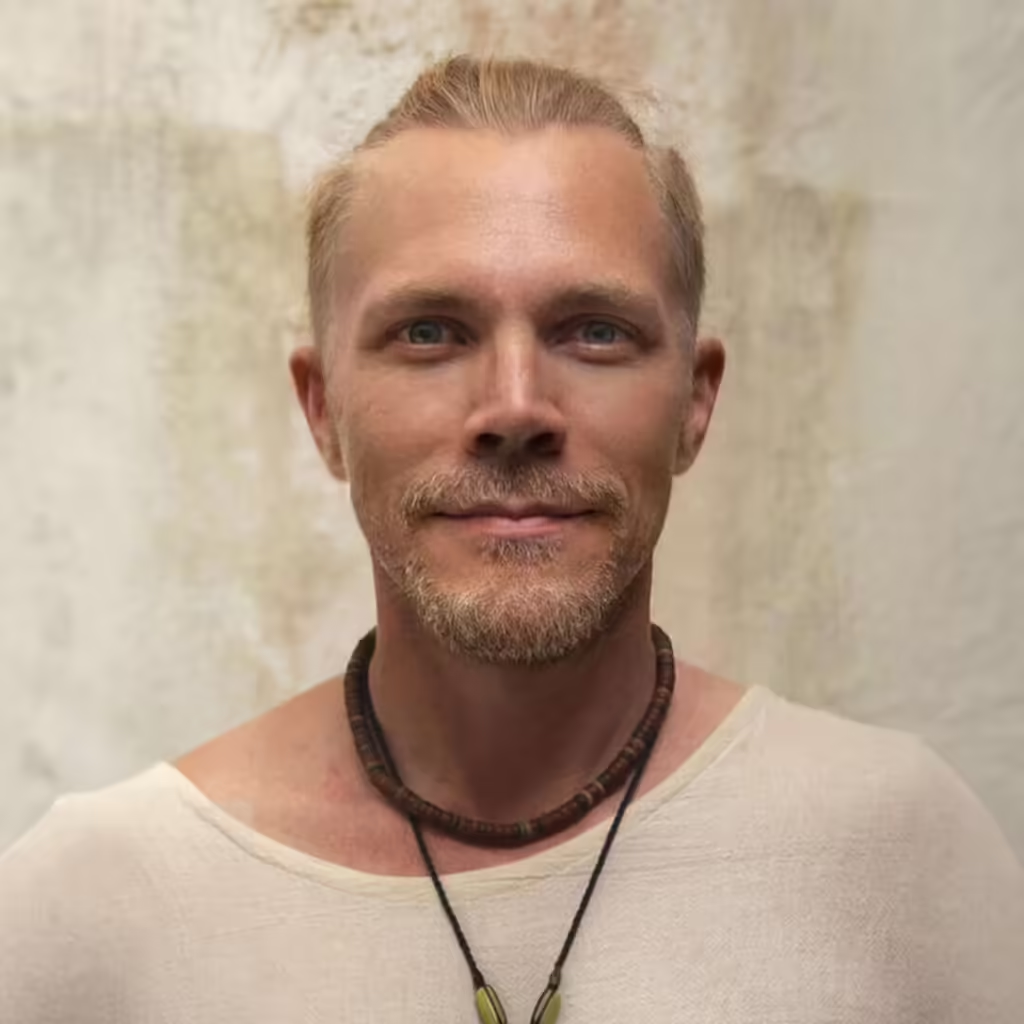
Jason Samadhi
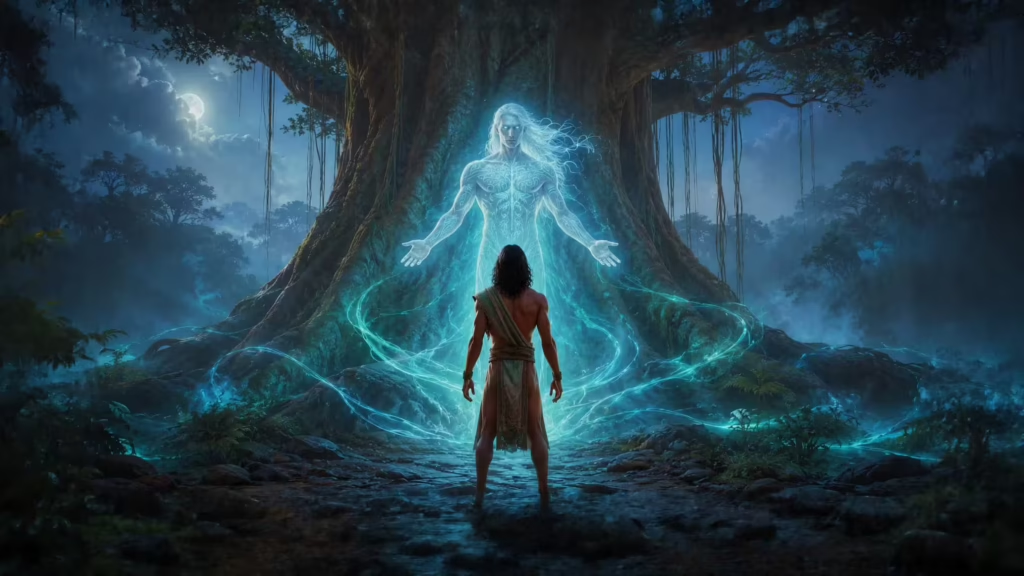
A Visionary Queer Journey
Step into the Lumina. Get your free sample chapters of The Aurelda Chronicles, an immersive queer fantasy series starter filled with sacred light and ancient memory.
Listen & Re-member
Aurelda Soul blends mythic storytelling, sacred wisdom, and grounded reflection for modern seekers finding their way home.
Find Your Thread
Download the free Seven Threads of Light Protocol, a primer for the upcoming The Book of Remembering by Jason Samadhi. Coming Soon.
